Based on a true swindle

Monday, 6 October 2008 — 4:05am | Adaptations, Film, Full reviews, Literature

So I’ve succumbed to curiosity and watched The Da Vinci Code. This may surprise those of you who mention Dan Brown in my presence at parties for the sole purpose of provoking me into entertaining you with an explosion of cleverly phrased invective against what is surely one of the worst novels I have read. All the same, I tried my best to see it with an open mind; good films have sprung out of bad books before, and I respect Ron Howard as a reasonable director of mainstream Hollywood pictures. This is, after all, the same Ron Howard who gave us the excellent Apollo 13 (a study in how to do a straightforward “based on a true story” dramatization well) and the admirable, if conventional A Beautiful Mind.

The Da Vinci Code is inherently an interesting case study in film adaptation, since the “novel” on which it is based is so incompetently written that the most charitable thing a reader can do is think of it as the first draft of a screenplay proposal by a ninth-grade kid who once got molested by a priest. And then there is the further gamble of handing it to the most erratic screenwriter in Hollywood—Akiva Goldsman, who wrote two of Ron Howard’s better films (A Beautiful Mind and Cinderella Man) but also has his name on the likes of Batman & Robin and I(saac Asimov is rolling in his grave), Robot.

Ron Howard, at least, has a track record that assures us he is literate in the art of cinema, which is not something we can say for Dan Brown’s grasp of written English (grammatical enough to be published, but only that). To film The Da Vinci Code in a manner that reflects the quality of its prose would require a handheld camcorder and a monk costume from the corner shop. That the adaptation is in the hands of professionals at all is enough to assure us that the delivery is an improvement—and it is.

Less expected is how the film manages to expose some of the serious defects in The Da Vinci Code‘s story structure that the book’s breakneck pace sweeps under the rug. Dan Brown’s novel is many execrable things, but one thing it is not is boring. (It’s like Sarah Palin that way—fitting, because Dan Brown’s America is Sarah Palin’s America in so many respects.) Ron Howard’s film is boring, and it is Dan Brown’s fault.
Continued »

Annotations (1)


Wednesday Book Club: The War of the Worlds

Wednesday, 1 October 2008 — 11:24pm | Book Club, Literature

This week’s selection: The War of the Worlds (1898) by H.G. Wells.

In brief: The weakest ingredient of Wells’ prototypical alien invasion story is the one that has left the greatest cultural legacy, the image of bloodsucking Martians in giant war machines obliterating the core of civilization and reducing it to an anarchic ruin while panicked citizens scramble for their lives. Far more intriguing are the periodic dip into social philosophy and the speculation based on Victorian science; the latter remains astonishingly relevant over a century later, now that ecology is emerging as one of the dominant issues of world politics.

(The Wednesday Book Club is an ongoing initiative of mine to write a book review every week. I invite you to peruse the index. For more on The War of the Worlds, keep reading below.)

Continued »

Annotations (1)


Dustbins of history, landfills of theory

Tuesday, 30 September 2008 — 11:54pm | Literary theory, Literature

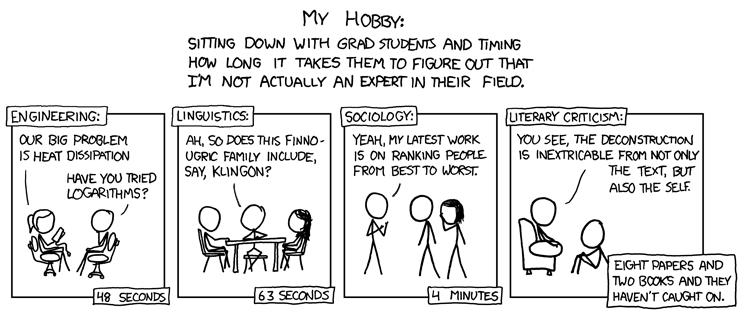
Scholars of the theoretical humanities (by which I mean the philosophical and literary species) would be wise to heed the post at Gene Expression bearing the belligerent and self-explanatory title, “Graphs on the death of Marxism, postmodernism, and other stupid academic fads.” The short version: an empirical scan of the JSTOR database reveals that many of the great buzzwords of theory, from “psychoanalysis” to “deconstruction”, are plummeting in prevalence in scholarly articles and citations. The author clarifies the methodology in a follow-up post, and then goes on to produce a set of graphs on “scientific approaches to humanity”, which I take to mean “investigations of material determinism and how far it extends.”

Naturally, this won’t amount to a hill of beans to the apologists who deny the existence of an empirical reality outside discourse and have no use for the positivist prejudices of the hegemons who have the nerve, the nerve to quantify things. Well, it’s their loss.

As someone who studied both the hard sciences and literary theory in considerable measure, I am compelled to make a few quick remarks of my own. If theory in its present incarnation is indeed collapsing, I lay the blame on what I like to call the Two O’s (ooh!): overextension and obscurantism.

Continued »

Annotations (2)


Wednesday Book Club: Le Ton beau de Marot

Wednesday, 24 September 2008 — 10:01pm | Book Club, Computing, Literary theory, Literature, Science

This week’s selection: Le Ton beau de Marot: In Praise of the Music of Language (1997) by Douglas R. Hofstadter.

In brief: What begins as a comprehensive study of poetic translation evolves into a treatment of human empathy and intercultural understanding, a refutation of John Searle’s Chinese Room argument against artificial intelligence, and a solemn remembrance of the author’s deceased wife. With its exclusive focus on language, Le Ton beau is a substantially less technical and more streamlined tome beau than Gödel, Escher, Bach; the mathematically averse may find it a more accessible point of entry to Hofstadter’s thought, as there is no talk of recursion or formal incompleteness in sight. Those who prefer their poetry devoid of metre and rhyme will take issue with Hofstadter’s conservative aesthetics; those who prize pattern, structure, and wordplay will rejoice.

(The Wednesday Book Club is an ongoing initiative of mine to write a book review every week. I invite you to peruse the index. For more on Le Ton beau de Marot, keep reading below.)

Continued »

Annotations (3)


Wednesday Book Club: The Brief Wondrous Life of Oscar Wao

Wednesday, 17 September 2008 — 12:32pm | Book Club, J.R.R. Tolkien, Literature

This week’s selection: The Brief Wondrous Life of Oscar Wao (2007) by Junot Díaz.

In brief: Astounding. How often do you see a serious (but ironic) novel about serious (but ironic) things like immigration, masculinity, and postcolonial despotism get away with comparing the Dominican Republic to Tolkien’s Mordor, casting a mongoose as a guardian spirit, and measuring acts of brutality in hit points of damage—and make it all look so genuine?

(The Wednesday Book Club is an ongoing initiative of mine to write a book review every week. I invite you to peruse the index. For more on The Brief Wondrous Life of Oscar Wao, keep reading below.)

Continued »

Annotations (2)


« Back to the Future (newer posts) | A Link to the Past (older posts) »