Triple-triple toil and trouble

Monday, 17 October 2005 — 10:28pm | Scrabble

It finally happened. After in excess of forty or fifty games in Edmonton and Sherwood Park, my undefeated record in the region fell off the rails tonight. I was hoping it would hold out at least until the tournament next weekend, but alas, it would not be so.

It wasn’t pretty. The wisdom that many a Scrabble-elder has passed me over the years is that if you fall way behind, open up the board. Too often, novice players get intimidated by an opponent who mounts an early lead, and succumb to the temptation to keep him or her from scoring; this is literally self-defeating, as doing it only keeps yourself from scoring. So the philosophy is to open the board, leave some gaps free, and set yourself up to plunk about thirty a turn with an occasional bingo for good measure.

There’s a very, very fine line between opening the board and being stupid, though, and it isn’t all that easy to discern between the two until all hundred tiles are out of the bag and the dust has settled. If it so happens that your opponent is the one drawing both blanks, two Ss, X, J and Z and capitalizes on every opening you were hoping to squat for yourself (as the gentleman across the table verily did tonight), then it may be some consolation to shrug and call it an unwinnable game where the tile gods screwed you for some karmic misconduct in a past life or tournament.

In the fashion of murdered spouse in a Cell Block Tango, I had it coming. I practically threw away a game on Thursday with a horrible play on my last rack that placed a Z on a triple line; it was a brain-fart of epic flatulence, and I only came back to win it because my opponent unwisely tried to play out with a phoney, which fed me an extra turn I didn’t deserve.

But as far as karmic imbalance goes, I did score a 550 that same night against an unfortunate newcomer, thanks to a last-minute ESQUIrE on a triple for 101 and a Z on his frozen rack. This is not my personal high – I once played a four-bingo 587 game, untimed, on a set that was missing an I – and my best tournament score remains 546, but this may be my new high score in club play. It was a casual sort of game also not under time constraints, so it only counts for so much, but oh well.

Aside from all that, I noticed – and you may have done the same – that I have been writing here less and less often. I’ve been busy, and telling the world how wonderful the Wallace & Gromit film was both times I saw it, and lamenting the tragedy of the Aardman warehouse fire that selfsame weekend (in my opinion, a neglected catastrophe), are among many relatively low-priority tasks that have been shunted aside in the face of more pressing issues. Some things are simply more important than others. Robert Bonfiglio is one such priority queue-jumper, as he is a master of his instrument outstanding beyond reach of all conceivable hyperbole, though I don’t have a CD to prove it because they sold out before I could get one.

The new Lemony Snicket is, contrary to my predictions, entitled The Penultimate Peril. Nobody knew this until less than a week ago, when it was leaked by a blogger who scored a copy early. (Don’t read the comments if you visit that post – they may contain spoilers. Don’t say I didn’t warn you, and definitely don’t say she didn’t warn you.) It’s still not too great a failure in state secrets to keep a title hidden from the public for that long when other, more powerful beings in the book business can’t even keep a firm lid on plot specifics like wizened wizards tumbling from lightning-struck astronomy towers. I’ll be picking up a copy tomorrow.

I’m reluctant to discuss my Calgary Flames at this point in the season lest I come out judgmental along either pole of the precarious axis of faith, but man, that 3-0 felt good.

Annotations (0)


A man of letters, peradventure

Sunday, 2 October 2005 — 8:04pm | Scrabble, Tournament logs

First of all, to those of you displeased with Telus – bugger off, buddy. It’s indirectly on their account that I have come by a pass to an advance screening of Wallace & Gromit: The Curse of the Were-Rabbit 7pm Wednesday. Yes, giving me free stuff is sufficient absolution of questioned corporate social responsibility, unless your name is Michael Eisner, and he’s not a factor as of last Friday.

“Is it just me, or is it a little odd to be ordering at a McDonald’s beside Bill Kinsella?”

Shannon Burns, lunch after Round 15

This year’s Western Canadian Scrabble Championship was full of stories that non-tournament players should have no trouble appreciating, so I will relate some of them here lest they be trapped forever in the lore of the competitive circle.

In the upper reaches of Division 1 in the second of the two Early Bird tournaments that precede the main event, Albert Hahn and Jason Ubeika came within 11 points of shattering the world record for the highest-scoring game of Scrabble (that is, considering the aggregate scores of both players). Albert played five natural bingos and at one point held a seemingly insurmountable 200-point lead, but Jason fixed that with a quick 176-pointer, VARIANCE on a triple-triple – one of four bingos, assisted by drawing both blanks.

Nevertheless, Albert comes out just ahead, 566-531.

Then in the main WCSC tournament, again in the top division where the players are skilled enough to make good use of outrageously imbalanced entropic disturbances in the string-field called Luck, Mike Early played a triple-triple of his own – ANTEFIXA for 212 points, which vaulted him to the highest score ever recorded at a Calgary tournament, 647.

Calgary’s own Jesse Matthews, who vaulted right past me and landed in the expert zone in the span of only two or three years, took home the golden horse’s ass for the Most Outrageous Successful Phoney – and boy, did he ever deserve it. On the first day of the main event he opened with a 60-point play that can be called both a monstrosity and a panflute virtuoso: ZAMFIR*. (You might remember his work from the tail end of Kill Bill, Vol. 1.) Outrageous? Nay, I’d call it outstanding. What’s more, he snuck it right past Dean Saldanha – a former Canadian Championship finalist and one of the best players in the country, my age or otherwise – without so much as a hint of brow-furrowing suspicion.

My own performance at the WCSC was satisfactory, I’d say. For the second year in a row I was the bottom seed of twenty in Division 2, barely making it above the cutoff with a rating of 1204, a mere shadow of the 1399 that was dismantled piece by piece at New Orleans last year. Given my field of competition, I was statistically expected to win five games of seventeen, but I outperformed it with a record of 9-8 (-237) – well out of the prize money at tenth place, but respectable. My tournament rating is going to shoot back up to around the 1280 mark.

The negative point spread, in spite of a winning record, is courtesy of Michelle Davis from Texas, who obliterated me 542-262 thanks to four bingos of hers to none of mine. I had not the good fortune of doing likewise to anybody else, though my 300-287 victory over her husband Carl was also a story to remember, and not only because I won $20 for posting the lowest winning score in my group. In this one, I was forced to block off and outplay a substantially more potent rack at the end of the game, DEIOSZ?. No, he didn’t have room for DOZIESt, but I put him in a position where he only had one play that would guarantee a win (in an attempt to minimize what I thought would be my losses), and he missed it. We both went overtime.

I received another $20 for “Living on the Edge” and having the narrowest margin over three wins of all the players in the tournament – +2, +4, and +9 for a total of +15. I would have preferred to score some points instead of doodling around with meticulous endgame mathematics, but the money’s nice.

The 21 bingos of mine that stayed on the board included three yucky ones: AMOEBIA*, STHENIAE* and SENTRIED*. (NERDIEST, while semantically appropriate, did not hit the triple word score.)

Next tourney: right here in Edmonton, Alberta on the weekend of 22-23 October. I’ll be playing in Division 1, since the cutoff is only 1200; this tournament skews lower on the rating scale because of the clubs in the region consist primarily of newcomers who have never played in competition before. (That includes you, dear reader. If you have an interest in the game but fear that the jump from trouncing your mother in the living room is too steep, this is the one you want to hit. Start before all the other Edmontonians get really good.)

Annotations (0)


Absence makes the Nick go ponder

Thursday, 29 September 2005 — 1:51am | Animation, Debate, Film, Literature

At this precise moment I don’t have time to expound on why contrary to what you might have gleaned from Jessica Warren’s review in The Gateway, but well in line with the mainstream press, Corpse Bride is certain to be the most lighthearted fun you’ll have at the cinema this year – at least, until we see hide or hare of The Curse of the Wererabbit. Whatever I said a few months ago about “So Long and Thanks For All The Fish” being a shoo-in for the Original Song Oscar is now seriously in doubt in the face of new and viable competition that almost makes the award seem like something other than an antiquated joke.

I will be investing in repeat viewings. You should too. Come for the exorcising voice of Christopher Lee and classic Mexican calavera cabaret in the same tradition as the epitome of interactive literature. Stay for the first and second best scenes involving pianos since that Polanski war film from a few years back, and stop to notice the Harryhausen nameplate.

So UADS alumnus Alim Merali, who has already taken his place in CUSID history by serving up the textbook example of a low-burden case, has self-published the introductory book on competitive debate that he’s bandied about for the past three years or so. Talk the Talk: Speech and Debate Made Easy has a strong pedigree of blurbs behind it already; a free PDF version of the whole text is available for online perusal. I can’t say I’ve dug into it myself, as the 152-page CUSID Central Debating Guide compounds a backlog of incredible girth.

As an aside, I normally entertain mail from my readers, but any and all instances of “So where’s your book, Nicholas Tam?” will be ignored with extreme prejudice.

You really can get anything published nowadays, though. Just ask Stephen Lanzalotta, author of The Da Vinci Diet: Weight-Loss Secrets from Da Vinci and the Golden Ratio. Picture me as suffused with ennui as I am once again forced to point out for those fetuses joining us after the commercial break that first of all, his name was Leonardo, and secondly, Dan Brown wouldn’t know the Golden Ratio if the plus-minus sign ripped the square root off the unsuspecting five and shoved it up his sacred feminine. Never you mind the inherent ridicule of this unwanted circumstance.

All-nighters, asymptotic complexity proofs and three-day Scrabble marathons don’t admix.

Annotations (1)


Not even remotely what you expected

Wednesday, 21 September 2005 — 11:52am | Video games

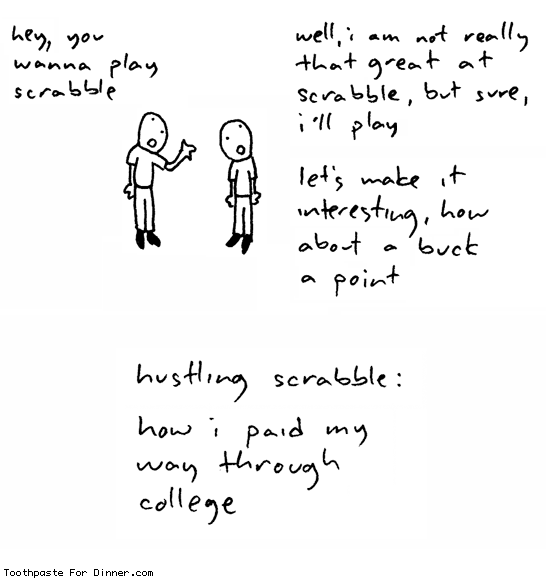
It is a fact that roughly a third to a half of the posts I sit down and write for this weblog never see publication. They are exclusively of the long-winded and moderately analytical sort, and I abort them for various reasons that differ from case to case. Suffice to say, not all of my candidate entries are founded on fully-formed ideas. Periodic abandonment is the price of writing for an ambiguous audience in such a manner that it is the words, not their personal association with the writer behind the digital curtain, that propel a subject with an efferent and centrifugal element of interest. The alternative is to reduce this place to yet another highly localized jokestop with an occasional amusing link to stick-figure cartoons that offer frighteningly-plausible proposals about how I might pay my way through college, and that I shall not do.

I sat down to write a gut-reaction post about the Nintendo Revolution controller pretty much the minute it was revealed in Tokyo Thursday night (with a spot of latency on account of receiving information through a correspondent and the press), embellishing it with dangling questions that were at the time unanswered for those of us sitting at home. This never got finished, as information kept rolling in all night, be it from the official press release or a direct-feed clip of Nintendo’s own concept video. By morning, there was a webcast of the entire hour-long Satoru Iwata keynote complete with synchronized presentation slides, and IGN posted a detailed FAQ answering most of the inquiries I had in mind.

(If you only click on one of those links, make it the video. It’s a doozy.)

By the same morning, online opinionation of the controller design was extensive enough, and diverse enough in both polarization and heat, that most of what I was originally going to post was redundant anyway. A lot of people caught on to the obvious implications: foremost among them, lightsabres. One observes that if LucasArts can get its act back together and not eschew the Revolution as it did the GameCube the past year or two, wireless lightsabre dueling is the obvious way to go. Of course, LucasArts isn’t getting much of an act together at all, which is why these guys are developing Sam & Max adventures and they’re not. But no matter – the point is, it’s not so ingenious that nobody thought of it, but it’s exciting enough that everybody wants it. So there you go: for those of you who are Nintendo sceptics – lightsabres.

It should be obvious by this point that my own thoughts on the subject retreated into a plain-text document where they could be tucked away and safely ignored.

From the standpoint of a traffic whore, this may seem counterintuitive, since gut reactions that suck in the immediate swarm of Google hits have a consistent record of inducing spikes in visitation rates sharp enough to impale a child of Ungoliant. But traffic whoredom is not my game; there’s some excellent coverage out there already, and I’m not going to compete with it. I think the impact of a reconfigurable and ambidextrous motion-sensing television remote has already been felt by the sheer depth of discourse it has inspired in its wake.

People are thinking about the video game business again and whether or not Iwata’s premonitions of doom about the heat death of the industry on the parapets of a lightning-struck tower are founded. Thought, like touching, is good. The soundest critique I have read distills the Nintendo philosophy to a cycle within which the Revolution controller is just the twelve-o’-clock bell of another iteration: seeding genres and letting other rivals populate them, resulting in the growth of the industry and a net gain for all or most.

As a side note of linguistic interest, it seems – from the official marketspeak from all parties involved in the console wars, of which the Nintendo press release is only a single instance – “hardcore” has been fully embraced into the lexicon of business rhetoric in the gaming sector.

From a more personal perspective, specifically as a game consumer removed from the question of whether the “remote controller” is an omen of death or rebirth… I think this is grand. First of all: lightsabres, baby. We’re talking about onscreen Jedi combat any way you swing it.

It’s more likely that the first killer app to adapt controller movements to melee weapon combat will be a Zelda title; I here assume that one is already on the drawing board, even though Aonuma’s team isn’t done yet with Twilight Princess. The 3D generation of Zelda adventures feature a masterful control scheme complete with context-sensitive lock-on actions to circumvent the nuisances of navigating 3D space with a device built on a 2D plane, but one of the design elements that never played out was the library of fencing tactics that resulted from certain button combinations: horizontal and vertical slashes, forward thrusts, spin attacks and the like. The distinctions are fun to play with, but are rarely necessary aside from poking Gohma in the eye every now and then. The combat system was a lot deeper than documented, but little of this is obvious. (How many of you knew you could do a spin attack with the Skull Hammer?)

Well, now we have an interface for navigating 3D space using an input device that operates in – get this – 3D space, and we have a motion-sensing system for total control over fencing techniques. One wonders, though, if Link will still be a left-handed character once under the command of a right-handed player.

Many are floating the question of the extent to which the eccentric interface will alienate multiplatform third-party developers. This is all part of a larger numbers game and is irrelevant to me as a game player.

Third-party support is a business concern, not a consumer concern. A lot of pundits out there make note of how owners of Nintendo systems almost exclusively buy Nintendo’s first-party titles, showing disproportionately overwhelming resistance to multiplatform releases that fare somewhat better on the Xbox and PlayStation 2. There are exceptions – Capcom’s Viewtiful Joe and Resident Evil 4, Namco’s Tales of Symphonia, EA’s perennial major-league statistical simulators that pass for sports games – but games like the first three I just mentioned are exceptional product; plus, they all started as GameCube-only titles.

The conclusion that is typically drawn from this curious observation is that either the GameCube is adopted as a second (and secondary) console, or Nintendo players are just a bunch of prepubescent kids. It’s certainly not a question of horsepower, as the PS2 is consistently overperformed by the other two. But these oft-heard excuses are gross oversimplifications. The real reason Nintendo satisfies, albeit to a niche (or more accurately, a wide array of differing niches), is because their appeal blends entertainment with almost pretentious arthouse sensibilities. It’s not the approach that attracts the largest market in raw numbers, unless you’re Pixar, but it helps retain a core audience that keeps the brand alive while it expands into nooks and crannies nobody even thought to consider. Call it the Apple stratagem.

In today’s segment of Penny Arcade, Jerry Holkins (“Tycho”) remarks that “for a couple generations now their systems have been (at least, outside of Japan) a kind of dedicated shrine to their own games, games that shame the rest of the industry with their polish, their palette, and their playability.” That pretty much sums up the real incentive for playing with the proverbial power: Nintendo, its first-party squadrons and immediate third-party allies are like real butter. Once you’ve had a taste, you can never go back to margarine. Is it a dream to live in a paradise where load times are a myth, Koji Kondo melodies fill the air and Hunter Metroids frolic in the skies? Nintendo’s world is that paradise. Some would call it a paradise lost. I say it’s regained.

If I buy one console next generation, it will be the Nintendo Revolution. It’s not because I have unswerving loyalty to Nintendo as a hardware manufacturer, because I don’t; owning Nintendo systems is an effect, not a cause. There are many critics out there who have repeated the claim that games are a software-driven business. True, but diversification of hardware is the condition that permits diversification of software, and that’s why it is no folly to laud the Revolution at face value. I have unswerving loyalty to Nintendo as a software developer, and have been well rewarded for it time and time again. Guess which platform you’ll find playing host to their interactive delights.

I’m not saying that the Xbox and PlayStation lines have nothing going for them, but while they have fairly substantial software libraries – something that will no doubt continue with the Xbox 360 and PlayStation 3 – when it comes down to it, the number of top-quality titles for each console is about equivalent. Then it boils down to a matter of taste. Will it be Metroid Prime, Wind Waker, Resident Evil and Paper Mario? Or will it be Halo, Ninja Gaiden, Jade Empire and Knights of the Old Republic? Or will it be Grand Theft Auto, God of War, Katamari Damacy and Metal Gear Solid? For the informed one-console consumer, that’s half of the choice. The other half is the forecast – the projection of what is to come, and which exclusively-bound software studios you can rely on to generate consistently stellar output.

It’s safe to say that unless investing in all three comes at almost no cost relative to your financial statement, you’ll miss something – so the real variable to consider is what you can’t afford to miss. And there’s no way in hell I’m missing Nintendo.

Going into the next generation, Nintendo retains a quantity advantage of its own: while its first-party release schedule is sparse, it won’t get any sparser, since the philosophy behind the Revolution’s design is to avoid driving development costs through yet another roof.

The unique interface would remove any Nintendo-PC overlap if there were any to begin with, and there isn’t – something that puts Nintendo in a considerably different position from the Xbox. Let’s admit this much: the Xbox is a machine for PC-style games – some of them excellent – that are better on a controller than a mouse and keyboard. It further succeeds because it avoids the seriously and perhaps irreparably flawed upgrade model that is killing the PC game business. At the same time, some games that would otherwise help justify an Xbox hardware purchase happen to play better with a mouse and keyboard; Knights, I’m looking at you.

If developers that prefer the conventional controller setup decide to abandon Nintendo, that would be a crying shame, but it won’t add as much appeal to the Xbox 360 and the PS3 as it properly should. If money were not an issue, one of the two (if not both) would be worthy of consideration out of technological fetishism alone. If you don’t believe me, watch the Metal Gear Solid 4 video and come back when you’re done slobbering. Everybody notices the quality of the textures and real-time cinema-quality effects, but what truly thrills me is the scope of imagination on display that validates the hope that yes, the next generation can provide designers new freedoms of expression the current one does not – so long as your imagination is capable of filling that expanse, in which case your name is probably Hideo Kojima.

The obstacle here is that Microsoft and Sony are trying to price one another out of business in the most peculiar way – by raising prices so high that buying the other guy’s console second is an impossible proposition. Xbox 360 retail bundles in Canada – for the real thing, not the skeletal Core System designed to rip off people who don’t take the time to read about what they’re getting for their hard-earned money – are easily going to cost upwards of $700 ($500 for the system and over $150 for bundled games and accessories that will undoubtedly be exactly the ones you neither want or need, plus the Mulroney tax); Ken Kutaragi has been prancing about for months telling everybody how elite and unaffordable the PS3 will be, so that’s almost a given. Then again, the PSP was considerably cheaper than expected. Then again, the DS slaughtered it anyway.

The result? Unless Nintendo really screws up on the first-party software end – and I don’t believe they will, given their stellar track record of telling everybody else how to make video games, then waiting a few years before telling everybody all over again – I now have enough information to say that I’ll be their customer twelve to eighteen months from now, and for financial reasons, likely theirs alone. Seeing the Revolution controller has solidified my endorsement, and I am eager to see what games they’ll come up with for the slender contraption.

Annotations (0)


Constant vigilance

Thursday, 15 September 2005 — 12:12pm | Adaptations, Film, Harry Potter, Literature

Keeping in mind that I’m not a stickler for correspondence to source material when it comes to movies adapted from books – relatively speaking, anyhow – I have a few observations to point out regarding the new Goblet of Fire trailer. Like a lot of trailers for big franchise movies that are near enough to release that most of the effects work is done, it shows everything – so if you don’t want to see everything from Hermione’s pink ball gown (yes, it’s pink here and not blue) to Lord Voldemort himself, avert your eyes.

First of all, the tombstone in the graveyard scene has been fixed. Early promotional images such as this one revealed an egregious error – that is, the presumption that Tom Marvolo Riddle’s dead father was also named Tom Marvolo Riddle, which was from the outset more improbable than the transfiguration of a pair of missiles into a sperm whale and a bowl of petunias, and then flatly contradicted by events critical to Harry Potter and the Half-Blood Prince. Near the end of this trailer there are a few shots from the resurrection in the graveyard (like I said, it shows everything), and the inscription has been corrected.

Much more irritating than anything else – and I suspect this will end up being my greatest annoyance with the finished product when I see it in November – is Dumbledore’s butchered pronunciation of “Beauxbatons”, which is similar to how they pronounce “Baton Rouge” in the drawl of the former Confederate states. Seriously, William the Conqueror died for this? Oh well – I suppose they already neglected to drop the silent T in “Voldemort”, so all bets are off. Now we’ll just have to deal with the premise that a Bulgarian kid learns how to enunciate Hermione’s name but the only one You-Know-Who ever feared stumbles over his French after a century of practice. What would really be upsetting is if the francophone characters do the same.

Like Cuaron’s flying Iceman Dementors in The Prisoner of Azkaban, there are a lot of neat visual inventions on display – Mad-Eye Moodyvision, Sirius Black speaking in the form of the embers in the fire instead of a disembodied head (which makes me wonder what will be done if they keep the scene of Umbridge fumbling about for his presence in Phoenix), and the rippling Jumbotron at the Quidditch World Cup, to name a few. I can see plenty of dynamism befitting the scope of the tale, a pulse that was sorely lacking in the Columbus films. Now that we have a pretty clear idea of the look of the film, the big question mark is the pace.

Annotations (0)


« Back to the Future (newer posts) | A Link to the Past (older posts) »