From the archives: Full reviews

Or, if you'd prefer, return to the most recent posts.


Sin City opens; Pope unavailable for comment

Wednesday, 6 April 2005 — 9:45pm | Adaptations, Comics, Film, Full reviews

Lately, I have been putting off the writing of those “movie review” things that certain readers ask me for when approaching me in person at those rare opportune moments when I emerge from my cavern to, among other activities, watch movies. I’ll present my reason, or excuse as the case may be, in the form of several premises.

Dispute these if you must, but let me propose the following. One who is most likely to benefit from a review in the traditional sense is one who has not seen a movie, which then allows me to exercise my relative position of discursive power to encourage or discourage the related expenditure that goes into said movie depending on whether it will lead to the betterment of one’s life and understanding of the much-ballyhooed “human condition” – or, alternatively, fund terrorist cells. Such reviews will normally consist of evaluating the different structural elements of production and how they add up, whilst approaching the narrative in vague terms so as to avoid spoiling the experience.

Reviewing a film, however, is not the same thing as critiquing it. The two are not mutually exclusive, but even when they work together, the former is just an extension of the latter, and reduces to the affixation of value judgments to certain interpretive products. The problem with these stickers that read “this is good” or “this is bad” is that not everything invites the label. As for everything that does, it gets tiresome after a while.

As a writer I far prefer engaging in critique removed from the judgment of whether or not something “works,” where I can tackle something and rationalize it for what it is, and only then go back to evaluate the argument’s validity.

At the level of critique, it is impossible to give a film – or any story, really – an adequate treatment without an examination of endings and spoilers. In other words, I much prefer to discuss movies with a certain audience in mind, that being the audience that has already watched the movie. Sometimes, that audience may never get to that stage without a prior recommendation, which is why I’ll occasionally tell people to get out, see the movie, come back and read the rest of the post.

Of course, there are always the party-crashers who read the whole post anyhow, either because of a slip of the vertical scrollbar or the fallback that “I won’t see it anyway.” So here’s my advice: don’t be a party-crasher. Go see Sin City.

I’d go into what an excellent film it is and justify that claim of excellence with one example after another, but that would get boring after a while. Here’s a capsule summary of my recommendation: Robert Rodriguez has just directed/”shot and cut” his landmark film, the performances driving the three protagonists (Bruce Willis, Mickey Rourke and Clive Owen) are endearing enough to draw one’s exclusive attention amidst the visual flourish, and as for that visual flourish, wow.

There. That’s your review. Get out, see the movie, come back and read the rest of the post. Now, let’s get a-critiquin’.

You will see a lot of people call Sin City a film noir genre piece and leave it at that. I would argue that it is on the whole quite a different beast, though I should clarify that this is not merely a semantic claim under some authoritative definition of noir, but my effort to draw attention to what makes Rodriguez’s movie unique in substance.

What interests me is how so many people will take a look at Rodriguez’s adaptation of the Frank Miller graphic novels, admire it for its production design and say “that’s noir” without identifying any specific similarities beyond the presence of pulp archetypes like disenchanted detectives, pernicious prostitutes and corrupt coppers. Yet they make special note of the amplified comic-book physics as antique vehicles soar above the pavement and a landed punch sends a thug across the room. They cite the explicit violence and casual nudity as distinguishing marks of the film. They fail to notice that the obtuse, centrifugal expression to be found in Sin City places it at the other side of the world from what makes film noir tick.

Film noir is not about sex, booze and violence. It is about concealment and innuendo. The lines of noir dialogue you remember are the suggestive propositions. That is precisely why film noir flourished in the era of Hollywood censorship, its defining female archetype the femme fatale seductress with something to hide. It should tell you something that the narrative mode most closely associated with noir is the mystery, a story of secrecy and revelation. It’s when you don’t see sex, booze and violence that film noir is at its most effective.

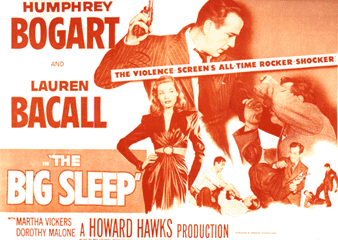
Let’s take a look at the Howard Hawks film of Raymond Chandler’s novel The Big Sleep starring Humphrey Bogart as Philip Marlowe (the 1946 theatrical cut, for the purposes of this discussion). In many ways, I consider both the film and book to be the defining noir story, even though they differ in some very significant ways, and even if it was The Maltese Falcon that “started it.” The Big Sleep was, at the time of its release, one of the most chilling thriller pictures on record. Promotional posters advertised it as “the violence screen’s all-time rocker-shocker.”

It’s hard to imagine this day and age, but it used to be that even one murder was a big deal. Casablanca was advertised as an action picture on the basis of the gunpoint threats and the grand total of two onscreen shootings. Nowadays we talk about the desensitizing effect of seeing the body count run into the double- and triple-digits within the span of a two-hour trip to the cineplex, but back in the day, every snuffing counted.

In The Big Sleep, the trail of corpses beats a lower bound of seven, in a bullet-ridden domino chain of crisscrossing motives and passions. And still, every snuffing counted. After Marlowe kills Canino, the one death he inflicts in the whole adventure, he feels and expresses a modicum of regret sufficient to warrant a kiss from Lauren Bacall.

The censorship regime did its own wonders for film noir’s self-assertion as a mode of storytelling specific to the cinematic medium. The central act of blackmail that sets the plot in motion – dirty pictures of Carmen Sternwood – is referred to in vague, implicit terms. Carmen is fully clothed when Marlowe finds her posing in front of the camera at Geiger’s residence. Marlowe’s amusing charade with Agnes in the bookstore is as someone with an interest in “rare books,” if you take my meaning. And then there’s the 1946 cut’s addition of that legendary dinner between Marlowe and Vivian, arguably Bogart and Bacall’s best scene together in all their collaborations, where they discuss sexual positions with the euphemistic vocabulary of equestrianism.

Chandler’s novel was itself was a rejection of chivalric ideals in favour of a new, gritty realism. Observe the scene (excised from the film, it goes without saying) in Chapter 24 where Marlowe discovers Carmen lying naked in his apartment, and notices an unsolved chess problem nearby:

I looked down at the chessboard. The move with the knight was wrong. I put it back where I had moved it from. Knights had no meaning in this game. It wasn’t a game for knights.

This, from the novel that defined the modern conception of hard-boiled private eye fiction beyond its foundations in Hammett’s Falcon. And to think that on film, yet more of it was left unsaid. Is concealment not what put the “film” in film noir? I hope I have dispensed with the notion with sufficient conviction.

With that out of the way, we lead ourselves back to Miller and Rodriguez with a blunt rhetorical question. Do Sin City and the words “realism” or “censorship” even belong in the same sentence? And I hope you’ve seen the film by now, because in answering that question, I’m going to spoil the film like crazy.

The case for the “no” side is obvious. The exaggerated sensationalism of sex and violence in Sin City places it in an ironic position antithetical to the realism inherent to its generic influence. This is not a negative criticism of the film, but of ignorant critics – both the proponents who will tell you what a good noir flick it is, and the detractors who see it as an exploitative abomination no more than a thin and pale mimetic imitation of the classic noir oeuvre. This is a film to be evaluated on its own terms, and any comparative study would do well to make note of differences instead of merely repeating the observable similarities.

That said, the observable similarities tend to appear in the film at its most critical heights of dramatic tension. For all the amputations, beheadings and castrations in the picture – and that’s just the ABC of Sin City‘s alphabet of gore – it is with the occasional, hardly-noticed spurt of concealment that it makes a brief return to the noir tradition, when what matters is not what you see, but what you don’t.

Perhaps the most noirish scene in all of Sin City is its opening scene, based on the story “The Customer is Always Right” and starring Josh Hartnett as a hitman unaware of his ultimate purpose. The composition exhibits a constructed whiff of nostalgia, and the characters are so fresh off the stock as to remain anonymous. The sudden, silenced jolt as he does away with his unsuspecting “customer” hearkens back to the decisive shot fired at the conclusion of the best noir mystery of the last few years, Spielberg’s Minority Report. Beyond the precision of the staging and the colour palette (black and white, a red dress and blue eyes), it all feels like an elevation of traditional noir conventions to a Platonic ideal. But the movie is just beginning, and something feels off about the scene beyond its manifest artificiality; later, we see that it is a deception in the face of the tone that follows.

The three stories that make up the movie proper aren’t nearly as subdued – what, with Kevin eating hookers and mounting their heads on the wall and Marv subsequently feeding his remains to the dogs in “The Hard Goodbye,” the entire Dwight chapter (“The Big Fat Kill”) centering on a game of hot-potato with Jack Rafferty’s severed head, and Hartigan ripping out a pair of pasty happy-sacks in “That Yellow Bastard.”

The violence does not provoke suspense, though – and it should be noted that it is altogether infrequent next to how some would describe the film. While it is in a sense extreme, it incites disgust at worst, but more often a sort of base and bloodthirsty pleasure. When the skinheaded thug played by Nicky Katt (the voice of Atton in the ending-free computer game Knights of the Old Republic II) is shot through the chest with an arrow, it’s damn funny.

But to me, the violence with the greatest impact is that which is concealed or shrouded – and I don’t mean offscreen. Of all the gunshots fired in the course of this 126-minute thrill ride, the best was saved for last. And you’ll notice that when Hartigan does himself in, it occurs in reverse silhouette, in the same negative space as when Dwight is drowning in tar – backgrounded as what is not present, a white cutout in a blank canvas. It is onscreen, yet it is absent. Or, in the case of the Yellow Bastard’s own ignominious end as he is pounded into a pool of piss-toned gunk, the pounding is obscured, and Hartigan’s rage is all the more visible precisely because the audience is distanced from its expression.

Shot after shot, Sin City drowns you in imagery you cannot fail to notice, thrusting it into the foreground. Film noir doesn’t do that. But every now and then, when you’re not looking, it hits you. It hits you the hardest when you don’t see it hit you, and that’s when film noir rears its shadowy head.

My point, to sum it up, is that one would do Sin City an injustice to praise or dismiss it as merely a parasitic digital-age iteration of a timeless genre infused with the aesthetics of sequential art. It is a dialectic synthesis of different philosophies and as a result, something both original and special.

Annotations (2)


The Knights Who Say "Knee!"

Monday, 14 February 2005 — 1:27pm | Film, Full reviews

Mid-February is a special time in that it is when filmgoers who do not have the fortune to catch early limited runs in Los Angeles, New York or Toronto ring in the new year. ‘Tis the season to write year-end summaries and forecasts for the season ahead.

I will do just that with the 2004 harvest in good time, as I have now left that year behind (aside from never having gotten around to the likes of Collateral and Hotel Rwanda) and seen the first theatrical release of 2005 worth mentioning, Ong-Bak.

On the surface, everything that happens in Thailand’s signature hit film is old and tired by what we have come to expect in North America. Tony Jaa plays a country boy who goes to the city, finds his former country-boy cousin turned urban gambler, fights in an underground boxing ring in a quest to recover an artifact of value from a drug kingpin, gets involved in an explosive car chase, and has a climactic final showdown with a baddie hopped up on steroids. We’ve seen it before, we might think.

That is, until we realize that the country boy comes from the villages of rural Thailand and ends up in Bangkok, a city of nine million – a disparity that really has to be seen to be understood, should you ever get the chance to visit the region; the underground boxing ring doesn’t feature just any boxing, but the ancient art of Muay Thai; the artifact of value is a sacred Buddha image of paramount importance to the villagers; the explosive car chase is on tuk-tukstuk-tuks! – and the final showdown makes for one hell of a good fight scene.

The novelty of Ong-Bak can be identified thus: can you name another Thai action flick you’ve seen? Didn’t think so. And what makes Ong-Bak interesting is that it is a celebration of all things Thai short of the blues compositions of King Bhumibol Adulyadej. I mean, a tuk-tuk chase!

In all seriousness, the thing that this movie will be remembered for is that it fills a gaping void in modern martial arts cinema, in that we really, really needed a Muay Thai superstar like Tony Jaa to burst onto the scene. Someone of his calibre is long overdue, and very welcome. Ong-Bak unreservedly exploits all of the distinctive characteristics of Thai boxing, particularly its emphasis on pummeling your opponent with your joints, not just your fists and feet of fury. Elbows land on skulls with an audible crack. Knees land on, um, people, with a sickening crunch.

The film sells itself as being free of CG and wire-work, but that’s just one of many ancillary benefits of an ethnic fighting flick being produced outside of the American studio system. The one that really shows is the length of the action sequences. It is rare nowadays to find continuous action sequences, rip-roaring urban chases and extended duels that comprise the majority of a movie without being repetitive, and nigh on impossible to spot this ever happening in an American-made product. Comparisons to 1980s Jackie Chan are entirely accurate, aside from the lack of slapstick comedy and Sammo Hung.

In terms of storytelling, everything of significance is flat-out obvious, but it is still worth noting. The obligatory string of one-on-one fights against increasingly burly Anglo-American thugs in the underground fight club are a prideful demonstration of the superiority of Muay Thai; if you follow martial arts cinema at all, you probably know that the superiority of the hero’s discipline is a recurring secondary theme whenever foreigners are present. (Or final-fight foes hopped up on steroids, for that matter.)

Then there’s how the evil mob boss atop the chain of command is a wheelchair-bound tracheostomy patient who speaks with an electronic device and smokes through his throat, but deifies himself as a god; recall that the plot revolves around the recovery of a stolen Buddha head, and you have a neat little parallel motif of headless idols going on.

And there’s a tuk-tuk chase!

Now, for some criticisms: like I said earlier, the premise of the film is about as standard as you can get from a modern action flick. Without the undercurrents that are distinctly Thai, which are thankfully almost ubiquitous, Ong-Bak would not be much of a film at all. There is only one reason to watch this movie – a very good reason, mind you – and that is to see superstar Muay Thai combat committed to celluloid. It would be nice if eventually, Tony Jaa is cast in something of real cultural significance and mythic quality; Thailand has a rich tradition to draw from, a tradition that is underexposed in the Western corpus.

The editing is tight for the most part, but one particular device grows tired very quickly due to overuse: the preponderance of sportscast-like instant replays of every particularly impressive stunt. I realize that the filmmakers may have been very impressed with certain takes, but for the sake of continuity and pacing, it is customary to pick your best angle and stick with it. Using such a device is excusable if done sparingly, but there are so many ooh-inspiring hits in Ong-Bak that the filmmakers just couldn’t get enough of it. Well, I did.

The last issue, and one that is actually an impediment to some of the fights, is that some scenes are shot in lighting that is so dim as to obscure the action. Yes, underground boxing clubs should be dark, but the thing about movies is that even in darkness, the audience can still see. Here, that is sometimes questionable.

There is a minor problem with the Magnolia Pictures edit that is in release here in North America, and that would be the addition of music that feels very much out of place. Dan Kaszor, who as I’ve remarked on many occasions is one of the few fellow U of A students whose knowledge of film I vouch for and trust, says in his Gateway review that the original music was none too great either, but one has to wonder if it were perhaps more tonally consistent. Personally, I don’t think foreign films should ever be tampered with upon local release, but I have the disadvantage of not being a major studio boss.

But these gripes aside, I recommend Ong-Bak for its offering of what is currently a one-of-a-kind experience in some respects. If it leads to the explosion of a burgeoning Thai boxing film industry of which the international community is aware, with Tony Jaa as its headlining celebrity, the world will be all the richer.

Annotations (0)


Mo chuisle, mo chuisle

Saturday, 12 February 2005 — 11:28am | Film, Full reviews

Predictability is an accusation of unpredictable relevance. When applied to literature, and film in particular given its inherent linearity and tempo, you often hear it used as a pejorative term. Apparently, stories are no fun if you can see the ending a mile away. Sometimes this is the case: the appeal of M. Night Shyamalan’s terribly overrated The Sixth Sense rests so completely on the wallop of its final revelation that for the perceptive types who pay attention to the clues before them, the movie is over as soon as they figure it out.

We like it when movies creep up behind us and smack us upside the head. We like it when gaps are filled in ways that surprise us. For recent examples, see Memento, Minority Report and A Very Long Engagement. For classic examples, see Citizen Kane and The Empire Strikes Back. But we remember these movies for their crazy twists not because of the shock value that comes of each successive discovery, but because every twist makes the story all the more compelling. You can go into Kane knowing full well what Rosebud is, or Empire knowing that Vader is Luke’s father, as I’d wager almost everybody does nowadays given how those epiphanies have become a part of our cultural consciousness – and the curious thing is, the film is all the better for it.

But that does not give us adequate grounds to say that predictability is necessarily something to avoid; again, it’s not about shock value. If you take a look at film adaptations of popular material, the most difficult thing to get over the first time through is what you can’t predict: deviations from a story with which you are already familiar. Here, we seek the comfort of a story we already know.

My point is, you can’t open a can of plot twists, sprinkle it all over a story and call it compelling. Sometimes you get an otherwise masterful film like House of Flying Daggers where the plot twists feel like chores that have to be done in order to lay out all the necessary elements of understanding that make the character dynamics work. When everything is on the table, it all makes sense; but here, unpredictability is not the source of causation. The film becomes compelling; the twists do not make it compelling.

I argue above that it cannot be universally considered a fault for a story to let the audience outpace it within reason, and nowhere is that clearer than in Million Dollar Baby.

If you have watched a lot of movies, boxing or otherwise (and truth be told, even if you have not), you will anticipate every single thing that happens in this movie. You will know exactly who wins every fight, who lands every punch, and every outcome of every critical decision the characters make, well before it happens. Part of it may be because the boxing movie has become such a defining subgenre of American film that we are all well aware of its techniques – not just how the director and editor time the punches, but how they build up to them in little spurts of tension and release.

How is it, really, that a boxing scene makes you, an audience member, feel like you are “part of the action”? I would posit that it involves a lot more than how visceral it is, how close the camera gets, and how resonant the bone-crunching sound effects are. To be a part of the fight, to be part of the experience of the boxer, also involves a replication of a certain anticipatory spider-sense. And in Million Dollar Baby, this is what happens both in and out of the ring. The sense of anticipation extends to the overall narrative flow.

But if you can see everything coming, how does the film keep you hooked?

Well, there’s the rub. You can see everything coming, but as a passive filmgoer in a darkened theatre, you are absolutely powerless to do anything about it. And in much of the film – particularly its final act, which is very much about helplessness – you can see it heading somewhere very uncomfortable. Here’s a movie where everything follows the natural progression of events that you should and do expect. You cheer for Maggie as she delivers a first-round knockout match after match, because she does what you expect of her, and more. You cringe as you perceive just how much harm is about to be done to her, but have no way of warning her of anything.

At the same time, that makes Frankie, Clint Eastwood’s character, an easy elicitor of audience sympathy. He is very much the same familiar character that Eastwood has defined for himself in his self-directed period, the William Munny archetype of an aging senior haunted by regret and seeking repentance. Like boxing, you’ve seen him before. But there are moments in the film where, as the cutman in the corner, he is just as helpless as the audience. Great storytelling, or what?

It is difficult to pinpoint how Eastwood pulls off this anticipatory elegance. Maybe it comes from a natural technical aptitude for foreshadowing. Maybe it comes of experience. In any case, Million Dollar Baby presents a curious contradiction – everything about it feels so familiar, every element feels borrowed (which is mostly the case), but the story draws you in anyway.

Curious, too, that in spite of its apparent predictability, I have been reluctant to speak of it in terms that are anything less than vague. But go discover it for yourself, and you’ll see what I mean.

Annotations (0)


Phantom’s spirit and my voice (in one combined)

Thursday, 23 December 2004 — 9:44pm | Adaptations, Film, Full reviews, J.R.R. Tolkien, Literature

I have seen both The Return of the King, Extended Edition, and The Phantom of the Opera. I’m going to analyse the second one first, because there is perhaps more to talk about – and that’s saying a lot. Mostly it comes of how the 250-minute cut of what was already a heavenly extravaganza solves pretty much every single niggling issue of initial adaptation-induced apprehension I had with the original cut. I quote from what I wrote a year ago:

ROTK may be the most successful of the three instalments in terms of not feeling harmed by its time constraints; but as with the first two, it has clearly set itself up to be a case where the DVD edition can and will eclipse the present cut for good. There are too many things that everybody knows were shot but mysteriously absent – the Mouth of Sauron, Merry being made Théoden’s squire, and at least one Gandalf-Nazgul confrontation – that ensure this will not end up being the preferred edition.

And it’s all there. Gandalf and the Witch-King face off, and it’s perfect. Merry is anointed as Théoden’s squire, and it’s perfect. The Houses of Healing make a brief appearance, and it’s perfect. The Corsairs of Umbar, the march across Mordor, Saruman and Grima’s fates (the omission of the Scouring aside, but to that I am already accustomed) – perfect. The Mouth of Sauron is damn well more than perfect. Like the other two Extended Editions, I am utterly baffled that I was ever okay with how some of these scenes were left out in spite of being filmed, and that Jackson still finds the theatrical editions to be more definitive. They’re not.

I am convinced Peter Jackson is Santa Claus. For three consecutive years, he has given me and countless others the Bestest Christmas Present Ever (or at least, for that particular holiday season). The Extended Edition could marginally qualify as a fourth. As further proof of the Kiwi director’s true identity, I offer the Elves.

But this year, my Christmas wish was for something that Jackson was not in a position to give. This year, the role of Cinematic Santa was entrusted to someone entirely less reliable, whose vision of one Harvey Dent played by Tommy Lee Jones was hardly up to par as far as legendary bearers of half-scarred faces are concerned.

Now, I think I’ve been a good boy all year, and all I asked for was this:

Joel Schumacher: please, for the love of all that is good and holy, don’t screw up The Phantom of the Opera.

This is one of those Christmas moments where I got my wish fulfilled in such a way that I wonder if maybe I should have asked for more.

So to answer the implicit question – no, Joel Schumacher did not screw up The Phantom of the Opera. In fact, it is his best film. (Take that with a grain of salt, as I have heard him acclaimed for Tigerland, which I have not seen.) This is clearly leagues above anything else I have ever seen him do, and as expected. much of it is on the strength of the source material – but that is not to discredit what he contributed.

Those of you who are unfamiliar with Andrew Lloyd Webber’s flagship musical should stop reading here and go see it. I deliberately leave “it” ambiguous as to whether I refer to the stage production or the film, but know that the latter more than suffices as an endearing introduction to the material, and I think it will last, though you might not come out of it with an understanding of why some people are just so darned crazy about it. But you’ll love the songs.

Before you go, however, I would like to offer this piece of advice: do not expect Moulin Rouge! or Chicago. Phantom is a completely different animal, and the first of its kind to make its way to the silver screen in what history will remember and already remembers as the movie musical revival of the early 2000s. It is not a fun movie. You will not be observing the whirling dervish of “Sparkling Diamonds” or the finger-snapping, toe-tapping vaudeville joy of “Roxie.” Phantom has a closer attachment to reality, and its visual stylings are conventional. It’s supposed to be like that.

That’s the difficulty of figuring out this movie: it feels so traditional, like it treads on a well-worn path, but there’s something almost indescribable that makes it distinct. It’s tempting to say that it hearkens back to the Oscar-winning wide-shot period epics of the sixties, but it is entirely more serious, and in a way, more subdued in the isolation of its setting. Here, there is no Grand Tour of Salzburg (The Sound of Music), New York (West Side Story), London (My Fair Lady), London (Oliver!) or London (Mary Poppins). There is no orchestrally-backed Overture and Entr’acte – something I attribute to the impatience of modern audiences, but that’s a different can of worms entirely. Phantom takes place almost entirely in an opera house, and this actually precludes it from qualifying as a Big Movie, spectacular-spectacular to use the old vernacular. It’s perhaps aesthetically closest to Beauty and the Beast, except in live-action and without Gaston gulping down a dozen eggs at a time.

The comparisons just aren’t going to suffice, so let’s get into specifics.

I went into The Phantom of the Opera with an apprehension that seemed familiar, the origin of which was difficult to trace. Ten minutes in, I figured out where I had last experienced it: Harry Potter and the Philosopher’s Stone. It’s an easy feeling to describe once you have identified it. The sets are great, but you would venture that they look a lot better in person on the soundstage. The pace is perhaps a bit rushed, and it’s like the movie is fighting to get to the parts everyone wants to see. The director doesn’t move the camera entirely enough, the lighting is rather static in such a way that the photography lacks a distinct voice of its own, and you wonder if maybe this project should have gone to someone with true cinematic acumen like Santa Claus – er, Peter Jackson.

(In all seriousness, this would have been an amazing Peter Jackson film. Maybe I’m still riding the post-Extended Edition high, but it’s fun to match great directors to musicals that suit their style perfectly, and I think this is a match – albeit one that will never happen.)

The first screening never truly suffices when a film is based on a source that is near and dear to your heart, or has played an instrumental role in defining who you are as a person and what you look for in art. You see it the first time to get used to the methods and madness of the retelling, and unless there are major complaints that you absolutely cannot work around, you see it a second time to get past that baggage as best as you can and evaluate its lasting power as a self-contained entity. To that effect, I think I am beginning to develop a vocabulary of the common sensations that may or may not appear in films of this sort. Here follows a glossary of a few that apply.

Diagon Alley: The moment when a shaky adaptation finally eases you in and makes you think, hey, I think I’m really beginning to like this.

Quidditch: The would-be showstopper that everyone wanted to see, but was not in any way close to being the high point of the film.

The Mirror of Erised: The scene that is definitive enough a representation that it secures the film’s place as the definitive treatment of the source, unlikely to see a remake in a very long time, if ever.

Balrog Moment: The scene that was perfect, exactly as you imagined, and made you sit up in your chair and squeal with glee as you mouth those too-familiar words in sync with the actors on screen.

Hobbit Reduction Algorithm: When a translation to screen creates a perspectival drift that moves the centre of narrative gravity away from the characters in which it lay in the source material; this can be for both good or ill.

You will notice that these are all from The Philosopher’s Stone and The Fellowship of the Ring, but this is for the sake of clarity more than anything else. There are reams of other terms you can graft from the likes of Troy, and historical adaptations can provide a lexicon of their own.

With that brief preamble out of the way, let’s talk Phantom.

It opens in the same way Butch Cassidy and the Sundance Kid ends, but going in the opposite direction – breathing life and motion into a grainy monochrome photograph that defines the aesthetic for all of the twentieth-century scenes. Yes, I said scenes – the 1919 auction is not alone in its depiction of the reminisces of the aging Raoul, though appropriately, it is the only part that features any dialogue. This sets the stage for the transition back to the timeframe of the main story with all the requisite elements – Lot 666, the chandelier coming back to life, and a very nice touch where the opera house floods with colour and the netting of spider’s silk melts away from the seats. On the whole, the transitions from 1919 to 1870 work a lot better than the other way around; fundamentally, they are not something that should be unfamiliar to anybody who remembers Titanic, but they serve their purpose on their own terms.

Through both the auction segment and our introduction to the various characters in the performance of Hannibal, everything was still a bit rushed and unsettled. When Carlotta (Minnie Driver) starts prancing about and being generally ridiculous, Driver plays her as such a caricature that one is unsure of whether it is intentional and praiseworthy or if it is too much. Later in “Notes” and “Prima Donna” the film provides the audience a better sense of where it wants to take Carlotta, but there is some initial discomfort.

Phantom finally shows off its first shining moment when Christine sings “Think Of Me,” and you realize that there is absolutely nothing to worry about on the casting front here. Emmy Rossum owns the role – she has the voice, the looks, the age, the demeanour, the talent. It’s a joy to see her break into song. This is less of a Diagon Alley than the satisfactory clearing of a hurdle that one is right to be concerned about upon entering the cinema, but take it and like it, because there is a lot to like.

“Angel of Music” draws no complaints, and makes for as good an expository device as it does onstage, if not better on account of the movie’s freedom of movement between sets. It possesses a lovely melody to begin with, and when the lights go out in the opera house as we approach the Phantom’s revelation in the mirror, we begin to get a sense of what a lavish and delicate production this is when it tries to be.

Then we get to the title song, “The Phantom of the Opera,” as the Phantom leads Christine into the catacombs. This is, in a word, Quidditch. In fact, the sequence retains something that the film should have dispensed with, which is the original orchestration. In my mind, it should have kept the organ, but none of that percussive eighties texture with a hint of electric guitar. Film gives you the ability to use a much better orchestra than the one you can typically afford to deploy in the pit, and it is puzzling that Phantom takes advantage of it almost everywhere but here. Some of Christine’s lines are also done in voiceover, almost with the air of internal monologue, and it lacks that visual drawing power of the lips that most take for granted until it is gone.

In the Phantom’s lair comes his signature solo, “Music of the Night” – and it is safe to say that depending on how discerning a listener you are, this is the make-it-or-break-it moment insofar as Gerard Butler is concerned – that is, if you have already gotten over just how young he is. His voice is haunting enough to set up the Phantom as a character, providing him with the emotive capability that he cannot express facially because half of his visage is concealed under the mask – but haunting does not equal powerful, and it is easy to wish the Phantom had a bit more stage presence.

For “Music of the Night,” though, Butler does his job. The real concern in this scene is a cinematographic one. The lair is lit by hundreds of candles, but even so, it had no business being that bright. This scene needed some shadow. In fact, it begged for it. It looks like the Hogwarts Great Hall, and it needed to feel much, much darker. The brightness does not stop the scene from being magical, though, and when Christine faints in the Phantom’s arms, the softness pays its dues.

And then we come to “Notes.” This is Diagon Alley, the turning point where Phantom gets so good that it drains away that tendency to criticize everything about it, no matter how good a time you are actually having. “Notes” is superb, and André and Firmin (Simon Callow and Ciaran Hinds, respectively) are an electric pair here and for the rest of their numbers in the movie.

At this point I want to skip ahead and identify what I think is as much of a Balrog Moment as a member of the audience, Lloyd Webber buff or otherwise, is going to find in this movie. There’s snow on the rooftop when Raoul and Christine make their way there, and it sets the stage for the glorious perfection that is “All I Ask Of You.” The full orchestra swells, just as I asked. The song is as beautiful as it always was, one of the most memorable duets to see the light of Broadway. But it’s the ambience of the mise en scène that takes a great song and weaves it into a truly beautiful scene. The number is simple, but lovely, and is probably the most outwardly romantic scene in any movie this year, with the possible and highly arguable exception of Peter Parker and Mary-Jane with their backs to the web near the end of Spider-Man 2.

“All I Ask Of You” captures exactly what it is that makes the best movie musicals shine: not only does the film capture the spirit of its source material, it adds to it and makes it better by taking advantage of a certain cinematic freedom, and sets the song to pretty pictures. Here, the film cries out with a voice of its own beyond what Lloyd Webber so generously provided, a voice that had up to that point been largely kept to a whisper.

You will notice that there is no mention of a chandelier so far. It falls, but not when you expect; this is actually not a reprehensible plot change at all, given that the lack of an intermission would have dulled the effect of a midpoint chandelier disaster anyhow. The repercussions are hardly noticeable.

“Masquerade” is as grand an ensemble offering as it needs to be, but it also shows a lot of restraint. More than anything, it demonstrates that Phantom is a song musical, not a song-and-dance musical. There is no showstopping choreography, but whether or not it would fit in the first place is a different matter. Upon the Phantom’s disappearance in a burst of flame like a certain Wicked Witch of the West we know, there is the interesting filmic addition of Raoul attempting to follow him, but winding up in a hall of mirrors that brings Enter the Dragon to mind. Yes, I kid you not – The Phantom of the Opera has a visual reference to Bruce Lee. But when you consider the mirror motif in the play, which translates exceptionally well to the film version, it makes a lot of sense.

Weirdness abounds when we get to Madame Giry’s retelling of her first childhood encounter with the Phantom, a story she recounts to Raoul. It is not one of the better scenes in the movie. While the visual rendition of the backstory is a serviceable substitute for generating sympathy for the Phantom’s condition – as opposed to it emanating wholly from his presence onscreen – it is not an example of the wonderment that occurs when movies augment what is provided by their sources. This is a very different kind of augmentation than the atmospheric direction of “All I Ask Of You,” – a less effective kind.

I am a completely satisfied customer with the entire sequence at the cemetery, for much of the same reasons as I was with “All I Ask Of You” – again, there’s snow, pretty colours, Emmy Rossum’s sonorous voice, and some images worth framing, or at least adopting as your computer desktop wallpaper. This is the “Wishing You Were Somehow Here Again,” like how the mixed bag that was The Philosopher’s Stone delighted us with the Mirror of Erised. A beautiful song, a beautiful scene – but with two adaptation issues to note. The first is that the Phantom does not shoot fire. Instead, he engages Raoul in a duel – good fencing in a movie where you don’t expect to see good fencing, though the way it ends is maybe a tad sloppy.

The second is that when Raoul rides into the cemetary, and the Phantom’s voice is speaking to Christine, he warns her, “That is not the ghost of your father!” The problem is, in the context of the film, none of us thought it was – and that makes it a curious line, as it is the only trace that remains of a slightly more explicit motif in the play, something that had to be eliminated by necessity here because the Phantom is so much younger.

And so we come to Don Juan Triumphant and “The Point of No Return.” Here the major difference between stage and film comes out. On stage, what part of the action you see is up to you and your decision of what to focus your eyes upon. On film, the editing room is in control, and seeing the reaction shots adds a lot of tension. Now, Piangi and the Phantom look so different in this scene that there is absolutely no believable way anybody could confuse the two, but the film works around this in an interesting way. The implication seems to be that gradually, everybody – André, Firmin, Raoul, the police – realize that things are getting wrong and wronger, but they sit in their boxes utterly powerless to do anything about it. Christine is the only one who can, and when she pulls off the mask, you get the tension-and-release dynamic of a well-staged sequence.

As Phantom nears its conclusion and the title character takes Christine into the catacombs one last time, there is the obviation that Gerard Butler’s best scenes are with the mask off. The scarring is subdued – again, the Phantom is no Harvey Dent, and rightly so – but enough that it amplifies Butler’s range of expression and finally encourages some audience sympathy for the broken man he portrays. After spending most of the movie relegated to a minimal role by a Hobbit Reduction Algorithm of sorts, the Phantom finally takes centre stage.

It all comes together very well, though as in “Music of the Night,” the Phantom’s lair is very brightly lit. In the play, it is just as full of candles, but the thing about a stage performance is that everything around the stage is shrouded in darkness, and it produces a certain level of intimacy that is not missing here, but certainly subdued.

One expects the credits to roll after the score hits its final cadence, the Phantom exits and everything fades to black – so it’s a shock when we are suddenly thrust back into 1919, with the old Raoul visiting Christine’s grave. It is at first a questionable decision, but is actually a very nice bookend of a touch when you see what Raoul finds there.

So, with that out of the way, let us formulate a holistic impression.

The cast ranges from arguably good (Butler as the Phantom, Carlotta) to perfect (Emmy Rossum as Christine, André and Firmin). Patrick Wilson as Raoul is a mixed bag – he’s great when he sings or plays off his chemistry with Rossum, but when he speaks, he is less effective. But whether or not a Phantom fan will like this adaptation really depends on his or her comfort with Gerard Butler, be it his youth, the timidity of his voice next to Michael Crawford’s more thunderous moments or how little screentime he has.

Phantom is different from most other musical adaptations in that it is told almost entirely in song. Whereas screenwriters such as Ernest Lehman once added clever and quotable lines aplenty that fleshed out the exposition, and the Fosse duo of Cabaret and Chicago were not all-out musicals so much as they were regular films with the occasional stage act, Phantom has little to no spoken dialogue. Aside from the chandelier and some cosmetic things like the lack of pyrotechnics at the graveyard, the film version hardly ever diverges from its source – but at the same time, it adds very little. Whenever it dares to infuse a scene with a personal touch, as it does in “All I Ask of You” and “Wishing You Were Somehow Here Again,” it amazes. “Notes” draws part of its elegance from Schumacher’s willingness to spread out his cast across his lavish sets, move them around, and move the camera with them.

The end result is that the film omits almost nothing, but adds very little – and that is perhaps its greatest source of disappointment. This is a very good movie, and one that I could see myself treasuring for some time to come – though further viewings will test that theory. But most of what is so good about it rides on the coattails of what Andrew Lloyd Webber already created. That is fine in the sense that I would imagine that Lloyd Webber is very satisfied with the end result, and most of the Fan Base of the Opera will be as well, depending on how militant they are about Butler not having Michael Crawford’s voice. It is really too bad that Schumacher offers such a faithful rendition already, but like Chris Columbus in The Philosopher’s Stone, sticks to the source in such a way that he does not dare offer anything for film buffs who find joy in movie magic beyond what the medium of origin has to offer – and this time, Alfonso Cuaron isn’t going to hop in and do it right two films later.

I am disappointed that The Phantom of the Opera, a great film with melodies you want to sing along with once you have the privacy of a home theatre and the DVD, is not one of the all-time classics in the pantheon of legendary movies. I am disappointed that it doesn’t gut you and rip out your still-beating heart like West Side Story. I am disappointed that it doesn’t stand a chance in holy hell of being a ubiquitous cultural phenomenon to rival the stage production.

But that’s the spoiled brat talking, who leaves no cookies by the fire and still expects Peter Jackson to send a masterpiece down the chimney. In the end, I got my wish. Joel Schumacher did not screw up; far from it, his film of The Phantom of the Opera is a keeper. Do yourself a favour and see it.

Annotations (2)


Persia On My Mind

Tuesday, 30 November 2004 — 8:55pm | Film, Full reviews

I never thought I’d be comparing Alexander the Great to Cole Porter and Ray Charles, but here I go.

These three historical figures have more in common than you would immediately suspect, but the most topical of these analogies is that all three have been the subject of recent biographical motion pictures that suffer from what is fundamentally the same problem.

Reading over my review of De-Lovely again, it shocks me just how many of the same criticisms can be applied to both Ray and Alexander. That is not to say that these films are equally compelling; they aren’t, and it is easy to stratify this trifecta on the basis of what they did right or wrong in retelling the struggles of a historical figure. Needless to say, this would make for an interesting comparative study.

Let’s begin with Alexander, as there is more to say.

I want to make it very clear that my verdict on Oliver Stone’s latest, after only one sitting, is that it is in no way an outright bad movie. Nor is its 173-minute running time inherently too long. To think that one could tackle such a subject as Alexander in less than three hours is folly, and is a sign that today’s audiences are either impatient, or just thoroughly spoiled by once-in-a-lifetime masterpieces like the three theatrical-edition instalments of The Lord of the Rings, where three hours apiece simply wasn’t enough. Mind you, I imagine that sitting through the historical epics of yore was an easier task when the intermission served as a pee break, but the element that permits enthralling Overtures and Entr’actes is a composer with the neo-Romantic bombast of Max Steiner or Maurice Jarre. In spite of the fact that his choral theme to 1492: Conquest of Paradise is better remembered than everything else to do with the film combined, Vangelis is not the man for the job. So yes, it’s three hours long. If you can’t take it, learn how to watch a movie.

This is not to say that Alexander doesn’t suffer from pacing problems; it most certainly does. That has less to do with its aggregate length than with the selection and placement of specific problematic scenes, and the storytelling structure as a whole.

Alexander‘s biggest structural problem is Ptolemy. It begins with old Ptolemy (Anthony Hopkins) in Alexandria, reminiscing about the glory days and dictating the story of Alexander to a scribe. The narration becomes an intermittent running commentary throughout the movie, so there is no question about this being a conscious stylistic choice. Well, it was a bad one. This is not to say that voiceovers are necessarily bad or that they never work, but Alexander is a case study in how and why not to use them. The first problem it presents is that far too often, Ptolemy talks and talks about what a legend Alexander was, how his companions will be lost in history whilst he will remain, and what a pity it is that nobody caught on to the great Alexandrian vision earlier. He shouldn’t have to tell us these things. The movie should be the addresser telling, nay, showing the audience that Alexander was great. If that fails, the movie fails. A narrator who goes out of his way to tell the audience how important a movie they are watching is a crutch that only serves as an accessory to that failure.

The second problem with Ptolemy’s narration is its use as a transitional device – or rather, a crutch for non-existent transitions between events that have nothing to do with each other, aside from their featuring that blond-haired guy played by Colin Farrell. We see a major sequence depicting something biographically significant – and when it’s over, we’re back in Alexandria with Ptolemy, where he tells us this happened. And then that happened. And then this happened. And then we get to this other part that, if you can believe our luck, we caught on film. Let’s see it.

This device makes much of Alexander play like a Greatest Hits album where half the songs have no business being there, but are included anyway. It is what Goldman would call “the good parts version,” but unlike The Princess Bride, they selected the wrong parts. The right parts would have something to do with each other, instead of floating in a sea of disconnected scenes.

Bio-pics are a challenge in that if you want to tell someone’s life story, it’s often a matter of crunching several decades into a two- or three-hour span. You need be selective, and you need to create a focused dramatic arc around that selection. Such dramatic arcs do eventually emerge in Alexander, but it takes a while before they materialize in an identifiable form. One would think that Stone and company would have it easy when dealing with a historical figure who only lived to the age of thirty-two, but that is apparently untrue. It’s almost like there was a checklist of essentials to get through; after all, one could not possibly hope to make the definitive Alexander movie without his taming Bucephalus, defeating Darius at Gaugamela, and preferring “both snails and oysters” (to borrow a sexual euphemism from Lawrence Olivier’s portrayal of Crassus in Spartacus). There’s nothing wrong with including them all, but only if they are connected by a cohesive narrative fabric.

By the end of the movie, it becomes easier to perceive exactly what it is Stone and his co-writers Christopher Kyle and Laeta Kalogridis are aiming for, but it still does not excuse the presentation of the overarching themes as being unclear in and of themselves. What Alexander lacks is a sense of causality.

Film is by its very nature a sequential medium. A certain sequence may depict an event in history, but it is defined by the scenes surrounding it just as much as it defines itself. There are few complaints to be had with Stone’s staging of the Battle of Gaugamela – it’s clean, tactical, and documentarian in its elegance. But there is a reason why it cannot be counted in the annals of the great cinematic battles: there’s no buildup.

And by that, I don’t mean the inspirational pre-battle address in the manner of Henry V. Show-stealing battle scenes are a matter of building anticipation, and exceeding it. This applies to the storyline as a whole. In Saving Private Ryan, we enter the re-enactment of D-Day not on the beaches where soldiers fight, but in the boats where soldiers puke. In The Empire Strikes Back, we have both offensive reconaissance and defensive preparations long before Admiral Ozzel ever comes out of hyperspace too close for comfort. In Lawrence of Arabia, we have a whole excursion across the desert that makes the ride into Aqaba all the more cadential. Let’s not even get into The Two Towers and The Return of the King and how they understood this to perfection, but consider the Last Alliance’s battle in The Fellowship of the Ring: no setup but a voiceover narration made for a scene that cannot be considered a dramatic climax by any stretch of the imagination.

In Fellowship, this was excusable because the end of the Second Age was a part of the prologue, and never claimed to be anything more. It was the only all-out army-on-army entanglement in the entire instalment, but one of the least gripping scenes. Alexander tries to do this with Gaugamela, but this is an hour into the movie. The rising action prior to the first wide shot we see of Alexander’s forces marching across the desert consists of Ptolemy telling us that Philip died, Alexander took the throne, and now we’re in Persia. So much for causality. So much for showing us how Alexander got there, or that the battle is at all deserving of the attention it receives.

That’s the main fault that Alexander suffers: things just happen for the sake of having happened in Alexander’s life itself, and not inductively from the premises of earlier scenes. The highlight of Oliver Stone’s career, JFK, got as far as it did not by showing one exhibit after another of disconnected evidence, but in putting the jigsaw puzzle together. As far as assembling jigsaws are concerned, it seems like Stone was trying to pull off a Citizen Kane of a life story without time, but the only thing he retained was a “Rosebud”-like deathbed shot where it is a ring, not a snowglobe, that crashes to the floor.

But that’s negativity aplenty. In spite of it, Alexander has its shining moments. Every now and then, there is an instance of discernible excellence, and one must appreciate the meticulous detail of Stone’s craft and visual imagination. And though it takes far too long and hops from one islet of ideas to the next, the movie eventually finds its footing.

There are essentially five things that Alexander ends up saying about its subject. The first and most successful statement is that Alexander’s motivation and ultimate undoing was an unswerving, quixotic desire to reach the ends of the earth and defy every obstacle in his way. This comes off rather favourably. In the best scene in the movie, Alexander shivers in the blistery cold as he overlooks the neverending panorama of the Himalayan peaks. They are not the seas he expected to find, so he pushes into India until those seas can be found. And as his troops suffer from the attrition of homesickness and fatigue, his authority and grandeur wanes until it is constrained only to himself. Yet he rides on, and the entirety of his personality is encapsulated in the scene when he is finally stopped, where he rides on into the thick of a jungle battle until Bucephalus rears up on his hind legs, dwarfed by an elephant doing the same. It’s an iconic shot, showing us that the only thing that could stop Alexander the Great was facing something greater than himself.

One cannot help but notice the irony of a movie about a character whose tragic downfall comes of overextension, when that movie’s own failing is that it overextends.

The second, third, fourth and fifth things that Alexander says are as follows: Alexander is Herakles, Alexander is Achilles, Alexander is Prometheus, and Alexander is Oedipus. In these respects, the execution is hit-and-miss. It is easy to appreciate minor touches like when Alexander wears a skin like that of the Nemean Lion, or the brief flashes of mythical etchings that he first sees as a youth that tell of the heroes and their violent fates. The Oedipal angle works from the beginning, and Alexander’s relationships with his mother and father make for one of the few lines of true continuity in the piece, although it could be said that perhaps Alexander’s more Freudian desires are explicated with far more in-your-face repetition than necessary. As Prometheus, Alexander delivers his own brand of the fires of creation to the world he shapes, and man as a universal being. His respect for conquered cultures as equals lends itself to this, as does the oft-repeated image of an eagle that equates him with his Persian nemesis Darius and foreshadows his analogous betrayal.

The Achillean angle is what falls flat on its face. Mostly, it involves drawing a parallel between Alexander/Hephaestion and Achilles/Patroclus. (This isn’t Troy, so no, they’re not cousins.) Ignoring for a moment that the usually-better Jared Leto (who plays Hephaestion) is a complete non-presence, Stone never really decides whether or not he’s trying to show the audience that in Alexandrian Greece, homosexuality was a societal norm. Bafflingly, the relationship is treated casually, but at the same time secluded. Troy, at the very least, had the balls to take a stance.

Lest this review degenerate into a replication of the Kerry-Bush rhetoric on gay marriage, let us proceed to a brief rundown of the more cosmetic elements like a good old-fashioned and respectable review that evaluates the film in terms of its components, starting with the actors. Colin Farrell displays the right sort of youthfulness for the titular role, and commands attention whilst on the screen. He has the poise of a boy conqueror whose achievements came too early. Alexander ages well; his younger self, played by Connor Paolo, is the spitting image of Farrell, who ages through an eight-year span quite well on his own terms. Val Kilmer’s performance as Alexander’s father Philip is the best in the film, and arguably the high watermark of Kilmer’s career. Much has been made of Angelina Jolie’s accent in playing his mother Olympias, but it lends to her exoticism in a way that matches her symbolic predilection for snakes. This does not stop her from overplaying the role in other ways that stop this from being recognized as one of her better performances, though it is clearly her most ambitious.

Alexander gets full marks for its visual design. The depiction of Babylon is picturesque, infused with epic grandeur, yet subdued enough that it does not overtake the foreground. Cinematographer Rodrigo Prieto delivers shots you want to frame, and convinces us that while snow-capped mountains and Subcontinental jungles are familiar sights, every new environment still feels like an explored frontier. There is a scene late in the film where Alexander is injured, and world around him becomes tinted with a swirl of red; it serves a function, but is nothing mindblowing, and will not appease anyone who is already annoyed with the film by that point.

On paper, Greece’s own Vangelis would seem the perfect match to score this movie. After a twelve-year absence from cinema, his return produces mixed results. The sombre, quiet piano melodies work; the synthetic percussion underscoring the bigger scenes ranges from insignificant to grating. This is nothing new, but nothing unexpected for the Chariots of Fire and Blade Runner veteran.

The dialogue is almost exclusively in a high and quasi-poetic register appropriate to the tone of the movie. As detailed above, the screenplay’s problems lie in structure. At the same time, it is clear that Stone lets the visuals carry most of the storytelling burden. Much of the dialogue is but rhetoric; and whenever the movie spotlights the dialogue over the images, as it does in the Ptolemy scenes and the more erotic moments, its weaknesses are bared for everyone to see.

The final verdict on Alexander is that it is neither excellent nor poor, but is a seriously troubled film that wavers between disconnected clumps of greatness and mediocrity. Judging by the vitriol directed towards it from both laypeople and the critical community at large, it is underrated, but not by enough to make it fully satisfying, either.

As an aside, it is curious to see how confused and beleaguered the reaction is to seeing a historical bio-epic position itself in contention for Best Picture in all the early rumour mills, then shoot itself in the foot, only to be shot even further once it’s down. It’s almost like they have no recent point of reference. How quickly we forget Luc Besson’s The Messenger: The Story of Joan of Arc starring Milla Jovovich, a movie that was subject to similar circumstances, and another that despite its almost universal panning, I found not half bad, but perhaps flawed (and evidently immemorable). The hostility directed towards Oliver Stone’s first real foray in a genre that most filmmakers dream of doing is likely not so much an indicator of a magnitude of failure, so much as a magnitude of disappointment. And to be honest, it’s not like we didn’t have reason to set our expectations high.

As a second aside, seeing Alexander reminded me of another film that was never made – yet another historical portrait of a thundering conqueror to be written and directed by a auteur-director with whom audiences had a love-hate relationship. Few now recall that Stanley Kubrick’s dream project was to film the life story of one Napoleon Bonaparte, and spent much of his life collecting Napoleonic memorabilia for the sake of research. The film nearly got off the ground in 1969, but the Rod Steiger-starring Waterloo, which nobody remembers, got squarely in his way.

The first time I read Kubrick’s script for Napoleon a few years ago, I remember being somewhat underwhelmed. Now I know why. Had it been made in that form, it would have turned out much like Alexander, in that it is a collage of events unified by an intrusive narrator. Now, screenplays only say so much – most of the storytelling in cinema lies in what you see on screen – but this tells us, at the very least, that to successfully build a cohesive narrative around the life and times of someone larger than both life and time is no small wonder, even for the titans of the industry.

The better biographical motion picture of 2004, Ray, has no narrator, but exhibits the same tendency as both De-Lovely and Alexander in that it is less a portrait of a man than it is a portrait of events, an approach that preserves biography at the expense of drama. The difference is that in Ray, the remaining drama works.

But that’s a different story for another day.

Annotations (1)


The gift of incredibility

Sunday, 28 November 2004 — 10:15pm | Animation, Film, Full reviews

“They keep creating new ways to celebrate mediocrity, but if someone is genuinely exceptional…”

This is what Bob Parr, Mr. Incredible, laments upon hearing of his son’s impending fourth-grade “graduation” in the best movie I have seen this year, The Incredibles. It speaks volumes.

I am not about to review The Incredibles. To do so would require me to do things like go on and on about composer Michael Giacchino’s throwback to the spy-jazz Bond-film musical textures of John Barry, employ comparisons to Alan Moore’s critique of the superhero’s place in civil society in Watchmen, and point out the subliminal commentary on the state of modern animation in the cameo by two of Disney’s Nine Old Men. There’s too much to say, and there will probably be even more the next time I see the film, as I quite inevitably will.

Instead, I want to begin with a look at something that is an identifying mark of any superhero story: what is it that makes the villain a villain. It doesn’t always come down to motive. Sometimes, the intent of the diabolical mastermind’s scheme demands sympathy; the master plan is meant to serve a noble purpose, but the point at which it becomes reprehensible is the means – say, for example, developing a permanent state of world peace and eliminating Cold War tensions by staging an alien invasion that kills half of New York. Earlier this year I looked at Spider-Man 2, the other “best superhero film ever,” and attributed some of its depth to how Doctor Octopus is driven not by a desire to destroy, but merely to complete his science fair project. The problem lies not in his wants, but in the ethicality of his means.

Sometimes there is a basic philosophical villainy to the motives themselves. Magneto, for instance, is out to destroy all humankind to turn the tables on the system discrimination against mutants. Branching outside the costumed superhero genre for a bit, we sometimes see literature make an open criticism of megalomaniacal technocrats – observe Totenkopf in Sky Captain and the World of Tomorrow, or Clement Armstrong in that classic episode of The Avengers, “The Cybernauts.”

Syndrome is easy to pinpoint. He is a reprehensible character not because he developed so potent a weapon as the Omnidroid, but because the personal philosophy behind his ultimate objective is in itself evil.

(Spoilers follow. Please go see The Incredibles if you haven’t done so already. If you have, see it again.)

Something I admire The Incredibles for is its courage in directly and openly attacking one of the most dangerous ideas in recent intellectual history, one that has understandably amassed quite the popularity amongst educators and others. It’s ever so fitting that this is identified in a scene where Helen Parr, Elastigirl, drives her son Dash home from school. “Everybody’s special, Dash,” she says. (“Which is a way of saying no one is,” he grumbles in response.)

The world Syndrome envisions is one where that very notion is true: a world where not only do true superheroes no longer exist, ordinary people artificially emulate their powers. Syndrome’s goal, in a sentence, is to kill off every last superhero so everybody can be super in their place. In short, never, ever put this guy in a room with Magneto.

Far from being purely grounded in fiction, Syndrome’s plot is an extrapolation of what will happen if we let jealousy of the gifted spiral out of control. This mantra – that everybody’s special – has already found its way into much of our society unchallenged. In the past decade or two, one of the most influential sources of educational direction has been the work of one Howard Gardner and his patently tautological theory of multiple intelligences. In a nutshell, what Gardner says is that there is no such thing as a general intelligence; rather, there are several mutually exclusive “intelligences” that apply to everybody in varying permutations. Think about it in terms of Dungeons & Dragons-like role-playing games where you redistribute a finite number of stat points between quantifiable character traits like Strength, Wisdom and Charisma.

Over the years, Gardner has added successively ridiculous layers to his model, such as the introduction of an eighth and ninth intelligence for people who are in tune with natural and spiritual issues, respectively. He has also quite successfully convinced educators all over the continent to structure their curricula according to his stratification of interests. The decline of the school as an academic body can be attributed to this trivializing of the classical trivium-quadrivium of the liberal arts in favour of a belief that if some students are academically stunted, that’s perfectly excusable, because we’re sure they have other talents anyway, so let’s diversify our schools so they can be good at something. The corollary of this is that those with a greater capacity for true genius – the gift of creative thought that leads to success in maths, music, Scrabble or what have you – are no longer more talented in a comparative, relative sense. And without relative greatness, there is no greatness at all.

When educational policies follow Gardner’s principles, curricula diversify to the point where vertical progression is no longer possible. School then no longer has any value aside from its role as a social incubator. By diminishing the focus on academics, we excuse illiteracy and similar deficiencies, and the impact ripples up as students are handed unearned diplomas every year. The one system under which accelerated progress can happen is in a system like what is promoted by gifted education programs, where learning is geared towards the needs of an individual in order to deliver him or her from the constraints of a severely limited academic experience.

But these programs rely first and foremost on a belief in giftedness, and it is precisely the belief that they should be universally accommodating that is destroying them from the inside. Special programs constantly subject themselves to the threat of overexpansion; complicit in it are schools that are all too willing to offer them to bargain for funding, ignoring how not that many students are gifted – and as for those who are, they are exactly the students in the most need of those “smaller class sizes” for which so many agree is a good thing.

Thanks to The Incredibles, we finally have a message in the mass media telling us straight up what we should have realized long ago: it’s ideas like a universal equality of talent that have shaped us into a culture that disrespects its heroes. We should not deny that some people are inherently special, nor should we justify such a denial with a claim that they are flawed in some trivial ways we are not.

It all reminds me of one of Douglas Adams’ essays published in the posthumous anthology The Salmon of Doubt, where he criticizes the tired old joke that they should build airplanes out of the same indestructible material as black boxes. His message: if a scientist knows better than you, don’t make fun of him. Adams goes on to exalt the likes of the Monty Python troupe for using their humour to celebrate a grasp of multiple languages, music, literature and everything we commonly identify as the cultural properties of the intelligentsia, no matter what Gardner says.

Now, what values does The Incredibles promote?

Well, more than one pundit has tossed Ayn Rand’s name into the ring. The essence of the argument identifies the moral of the story as a plea to respect the talents of your betters. (And when Mr. Incredible lifts the Omnidroid v8.0, does Atlas shrug or what?) While that is an admirable statement, The Incredibles is a lot more than just that. Mr. Incredible may be super, and that’s why the society he lives in pins him down, but that’s not what makes him a hero. What makes him a hero is how he uses his powers to do the right thing. Moreover, he feels a responsibility for doing the right thing just because he can; and he does so not in any way at the expense of ordinary folks, helping out the little old ladies who don’t have the super powers of outwitting a bureaucratic insurance agency.

The irony is that at first glance, perhaps Syndrome isn’t all that different. He has a natural gift to call his own, that of technological innovation – just take one look at the rocket boots he invents as a kid. He, too, is interested in the deliverance of those he identifies as his peers. Syndrome is a superhero of the Bruce Wayne variety, but he lacks two things: first, the insight to recognize his gift, which he forsakes or ignores in order to identify with the common people; and second, the moral character to use that power for good. His goal is to destroy his betters; his error is a presumption that he speaks for those he considers his kin. In the end, it is in fact Mr. Incredible – the one with the inherent biological speciality of super strength, as soon as he loses a few pounds – who truly acts in the interests of those who are unable to help themselves.

It’s compelling that for all the talk about Mr. Incredible as a Randian hero, to put it in Marvel Comics terms, he’s a Xavier, not a Magneto. Xavier, if you’ll notice, is an educator who promotes co-existence, and cites the respect of aberrant talents as a pre-requisite. Magneto seeks to destroy those by whom his talents are maligned. That’s the difference, and that’s what gives The Incredibles its admirable value system.

The ultimate betrayal of our heroes is when we cease to recognize their heroics. Even worse is when such an environment puts them in the position of ceasing to recognize themselves as special. If we go down that path, celebrating mediocrity is all we’ll ever do.

Annotations (2)


The Sharks are gonna have their way, Tonight

Sunday, 24 October 2004 — 10:37pm | Animation, Film, Full reviews

I was going to say a few words of praise for an absolutely phenomenal gangster movie involving sharks, but most of you are already well aware of my opinions concerning West Side Story.

Instead, I’m stuck talking about Shark Tale, which cannot be faulted for not being a finger-snapping rhapsody of forbidden love and close-quarters switchblade combat – few movies are – but can hardly merit a strong recommendation of any sort, either. I’ll say this much: it exceeded my expectations, which were not all that high to begin with. Judging by Antz and the two Shrek films, PDI and DreamWorks Animation appear to be exercising a repeated application of a specific marketing formula: a) sell your film to the mainstream audiences who like loud, obnoxious fart-joke comedies so they can pay their ten bucks and laugh in unison at the exact same jokes that everyone already saw in the teaser trailer, and b) pull the rug out from under the snobby critical types who write for such pretentious rags as The Chicago Sun-Times and Nick’s Café Canadien by delivering some semblance of a genuinely compelling product.

As far as the second part is concerned, they kind of did, and they kind of didn’t.

By now, nobody should doubt that the production designers and animators over at Pacific Data Images know how to paint a pretty picture. At first glance, Shark Tale looks tacky. Sit through 90 minutes of it, though, and the tackiness sinks in as a cohesive aesthetic that fits the tone and character of the piece. Observe the first shot in the movie: the worm that wiggles and squiggles about as it is cast as bait into the open sea has the worrisome sort of bulging eyes that reflect the precise absurdity of its predicament – especially when a docile shark comes along and sets it free.

Later on, said shark (Lenny, voiced by Jack Black) paints himself a light turquoise and dresses up as a dolphin. One scene features a derby of galloping seahorses where the favourite is, of course, Seabiscuit. The reef on the ocean floor is an aquatic Times Square, complete with a Coca-Cola billboard in a half-joking promotion on the scale of the giant Mountain Dew can in Antz. In many ways, Shark Tale is your average inner-city Manhattan movie that just happens to deliver its visual narrative in the environment of a marine ecology.

That’s where the film’s problems begin: it tries so hard to be oh-so-trendy in that I-love-NY way that it gets swallowed up in the whirlpool of its overplayed pop-cultural consciousness. Not the least of its expressions of that consciousness is in the way its characters are built around the actors, a celebration of a negative trend in the film industry today.

Yes, one has to admire how Lola, the seductive, dusky fish who speaks in a velvet contralto and lets her fins droop around her face like a wind-swept curtain of wavy long hair, is the spitting image of Angelina Jolie (who provides her voice), right down to the all-too-appropriate trademark fish-lips. The problem is when that becomes the be-all and end-all of the movie – compounded by the fact that one of your high-profile voice actors, the one who plays your main character, Oscar, is Will Smith. And if I, Robot were I, Any Indication, the last guy in the world you want Will Smith to play is himself.

As a pessimist would rightly guess, Will Smith walking onscreen – vaguely disguised as a fish designed to look and act like him – is exactly what happens in this movie. And from that point on, it’s all downstream.

That’s not to say Shark Tale elicits all groans and no laughs. It fulfils its minimum academic requirement of three Titanic jokes. It makes reference to a whole bevy of other films, most of which are in some way related to its cast, like they got a good laugh out of mocking the clichés that have developed out of their own filmographies.

Note my choice of words there. It doesn’t spoof other movies, it makes reference to them. There’s a difference. References are trivial allusions that amuse in the act of being identified – like Rex chasing the toy car as seen in the rear-view mirror in Toy Story 2‘s second-long poke at Jurassic Park. References have their limits, in that you can’t build an entire movie around them, like Shark Tale tries to do with The Godfather. There are better ways to do The Godfather with sharks – or even Jaws, for that matter, as when it is performed by bunnies.

On a more positive note, though: sharks humming the theme from Jaws, I’ll admit, is pretty darn funny. Shark Tale has these bright spots, and Will Smith aside, it doesn’t annoy so much as it impresses in very limited spurts. It’s a temporary pleasure, dispensible after its hour-and-a-half is up, and not quite so bad that you feel dirty for having been reeled in by its thundering pace like some novels I know.

Wait for the DVD. Being from a digital source and all, I’m sure the transfer quality will be excellent. Rent it when you’ve caught up on any theatrical necessities you may have missed – Garden State and the like. I remain almost disappointed that the animation didn’t stink, or I could have used a quotable closing remark like “Shark Tale bites.”

Annotations (0)


« Back to the Future (newer posts) | A Link to the Past (older posts) »