From the archives: Animation

Or, if you'd prefer, return to the most recent posts.


The top ten Looney Tunes cartoons

Friday, 19 December 2008 — 11:21am | Animation, Film

Answering the call of animation historian and Warner Bros. expert Jerry Beck, there is a lively discussion at Cartoon Brew of the best Looney Tunes shorts of all time. Ordinarily I abhor doing rankings and writing up lists, but people read them, and there’s no better way to introduce audiences to the classics of the vast, vast Warner repertoire than to put them on an enumerated pedestal.

Obviously, there is never a consistent set of criteria for determining the “greatest” of anything. I decided to look for shorts that would be somewhat broadly representative of the Looney Tunes brand’s leading directors and staple characters in their finest moments, taking into consideration both historical value and the nuance of the animation itself. As with books, music, and live-action cinema, I like to reward works that show off what the medium can do, but not at the expense of a clear and engaging story. Ties were broken by personal taste.

My list will reveal that I have a strong preference for director Chuck Jones, particularly his legendary unit with background artist Maurice Noble and storyman Michael Maltese. Not to downplay the talents of Friz Freleng, Robert McKimson, and others, but I think most Looney Tunes aficionados end up gravitating towards one of Chuck Jones or Bob Clampett, since they represent two contrasting ideals of what the animated cartoon should be. Jones is to Clampett as Sonny Rollins is to John Coltrane on the tenor saxophone: one is known for the elegant clarity of his inventions, the other for his unrestrained virtuoso insanities. (On further reflection, the better analogy may be to Oscar Peterson and Thelonious Monk.) It’s not out of the ordinary to admire both styles, but adore one more than the other.

I came up with a clear and likely interchangeable top four, which I had to shuffle a few times, and limited my list to ten. Without further ado, let’s begin with #10 and work our way down.

Continued »

Annotations (0)


American People Accidentally Enjoy Family Guy

Friday, 14 November 2008 — 3:36pm | Animation, Film, Television

The funniest thing I’ve read all week: “Indian People Accidentally Enjoy Roadside Romeo.” For those of you who don’t know, Roadside Romeo is a Disney-distributed CG production by Yash Raj Films that I have heard described as a Bollywood Lady and the Tramp; you can watch the trailer here, if you dare. It’s also a runaway hit. Amid Amidi proposes that all animation be removed from the nation of India, and I think he’s only half joking:

We’ll try the plan for two years. Don’t worry, good ideas like this take time. When the fine people of India feel they’re good and ready to respect the animation art form, I will personally send over a print of One Froggy Evening. If you enjoy that more than you did Roadside Romeo, we’ll send you Dumbo the following month. If you still enjoy Roadside Romeo, we’ll take more drastic measures like defrosting Walt and sending him over to help you see the light. Either way you’ll finally be able to see that your enthusiasm for Roadside Romeo was one huge terrible fucking mistake. Don’t feel too bad, even animation-savvy countries make mistakes sometimes.

It’s a satirical piece (“Additionally, any DVDs containing animation can be dumped in useless neighboring countries like Pakistan and Bangladesh”), and all the more effective because the plan would garner my full support. Honestly, sometimes I think we need drastic measures like this right here in North America—my fellow Canadians, that includes you—and I can’t think of a better remedial syllabus.

Let’s set Roadside Romeo aside for a moment, since I haven’t seen it. When India pulls off its equivalent of Spirited Away, which earned its way to becoming the biggest domestic success in the history of Japanese cinema by also being one of the best animated features in recent memory, then we’ll talk. Of far greater concern is the link in the last sentence I quoted. The Cleveland Show? This is like milking a diseased cow. Is Seth MacFarlane out of his giggity mind?

I make it no secret that I consider Family Guy a televised disgrace, a cancer upon the storied art form of Walt Disney, Bob Clampett, Chuck Jones, Hayao Miyazaki, Nick Park, Brad Bird, and everyone else who belongs on my abbreviated list. And that’s to speak only of its offence to animation, never mind comedy (or, for that matter, Americana). I’m not sure when it became fashionable to equate “adult” animation with crude construction and crass immaturity; I grew up believing that adults were people who grew up. Maybe this is the same audience that never grew out of the adolescent sensibility of feeling too cool for cartoons.

The Family Guy franchise bothers me considerably more than the usual decadent pop-culture rot because of how it has managed to swindle so many otherwise intelligent people, possibly including Seth MacFarlane himself, into believing that it is in any way clever. It’s dumb-as-bricks entertainment that purports to be smarter than the average bear. It’s like a Dan Brown novel (which makes the ineptitude of Family Guy‘s onetime jab at The Da Vinci Code all the more ironic), though it casts a loftier net. At least trashy bestsellers fill the coffers of publishers who can then make risky gambles on unknown authors. (There was a rumour going around that Doubleday’s recent layoffs happened because they expected the next Brown novel to show up on this year’s ledger, though it was denied.) Family Guy begets more Family Guy, be it in the isomorphic stupid-to-make-you-feel-smart sitcom family of American Dad or the selfsame nucleus in The Cleveland Show. It has no excuse, and I will celebrate when it dies.

One often forgets that Warner Bros. Looney Tunes and Merrie Melodies cartoons attempted spades of pop-culture “references” (as distinguished from parody). Shorts like Hollywood Steps Out have declined into trivial irrelevance for all but the most serious collectors, and I say that as someone who recognizes classic film stars like James Cagney and Edward G. Robinson; still, at least the drawings back then were actual caricatures. And one would have to admit that 8-Ball Bunny gets a little stale by the third time Humphrey Bogart’s character from The Treasure of the Sierra Madre shows up to pester Bugs.

True classics like One Froggy Evening will prevail as they always have, as will the best of the parodies—your What’s Opera, Doc?, your Carrotblanca. And there’s no question that there’s a lot of great animation being produced today, be it in North America, India, or anywhere else. The problem is the undiscerning audience that never sees any of it, and is stuck with deplorable examples of what animation can do. Unfortunately, that audience comprises a great many people. Some of them may even be your friends. I fully support their systematic inoculation, and if we have to haul Uncle Walt out of the freezer, so be it.

Annotations (2)


Ties, damned ties, and sadistics

Monday, 3 November 2008 — 1:50pm | Animation, Film

Le noeud cravate / The Necktie

In commemoration of World Animation Day, the Metro Cinema exhibited two free, back-to-back screenings of National Film Board shorts: a kids’ programme, and another one. I’m not sure what the criterion for inclusion in the children’s screening was, though the films in that package tended to be the ones with a more straightforward attitude to story.

The kids in attendance loved it, at any rate, and broke out in applause at the end. I don’t think I’ve ever seen that among children outside of packed advance screenings and Pixar opening nights. What a treat it must be to see a whole new generation of potential NFB classics at so young an age, when one pays little heed to the finer subtleties of design and technique, but bathes in the overwhelming effect; the age at which a card trick is real magic.

Here in Canada, many people my age who think they only have a casual exposure to animation probably have vague recollections of The Cat Came Back or The Log Driver’s Waltz flickering across their television sets. NFB animation is truly one of the government-funded arts initiatives that is successful even by the Stephen Harper metric, and it isn’t at all a case of nationalistic self-aggrandizement to acknowledge that it has made this country a world player. And considering how many of the best shorts come out of Quebec, I’m glad they’re still here.

As for this weekend’s films: there was a lot to like, and I reserve an especial fondness for the hysterical India-ink anachronisms of Claude Cloutier’s Isabelle au bois dormant (Sleeping Betty) and the punch line that caps off the rhythmic metamorphosis of Malcolm Sutherland’s Forming Game. But there was one film that was the very height of magnificence: Le noeud cravate (The Necktie), Jean-François Lévesque’s mixed-media meditation on the horror of the lifelong dead-end job.

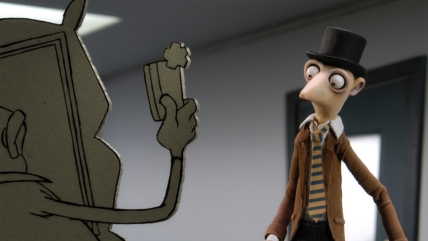
Le noeud cravate was exhibited in both screenings, so I had the pleasure of seeing it twice. I don’t want to give away its most shocking moments, so a careful synopsis will do: a young man receives a striped necktie as a graduation gift, packs his accordion away, and ascends the skyscraper of the aptly named Life Inc. As he rises from floor 25 to 39, the necktie tightens around his neck like a noose, his briefcase overflows with paper, and he develops a hunch. At 40, the only three-dimensional person in an office of 2D worker drones, he wakes up to the realization that he has spent his life sitting in a dimly lit office ironing crumpled paper for no reason whatsoever—so he takes the elevator to the top floor to see what lies ahead.

More than that, I won’t say; you must see it for yourself. I haven’t seen enough of the field to know what the competition is like, but Lévesque’s piece is without a doubt comparable to the quality of past Oscar winners, and I hope it ends up on the shortlist this year.

Annotations (0)


There is no new Star Wars movie

Friday, 15 August 2008 — 10:14pm | Animation, Film, Star Wars

Before you read any further, observe these choice photographs of costumed Disneyland employees being arrested. They will set the tone.

I’ve noticed a bit of confusion in the air owing to the fact that cinemas are booking something called Star Wars: The Clone Wars this weekend. Lots of cinemas, actually—3,452 at last count, placing it on the order of a big summer release (and take special note of how I’m not going to call it a “film”). Well, the throngs of uninformed consumers out there are the primary audience at the multiplexes anyway, so you might as well cast a wide net.

The fact is, anyone who pays the least amount of attention to Star Wars (and if you aren’t, why would you watch this release?) is, or should be, fully aware that The Clone Wars is nothing more or less than a television pilot for a spin-off series that follows the footsteps of a long line of spin-off series, though the subject matter probably allows for more lightsabre duels and space battles than Droids or Ewoks did back in the ’80s. This might appeal to the individuals who will swallow anything as soon as you stick a Star Wars label on it—refer to your local bookshop’s “Science Fiction & Fantasy Series” shelf for details—but I’m not fooled for a second. I, for one, am quite aware that the seedy underworld of Star Wars spin-offs has historically produced nothing of value whatsoever, with the notable exceptions of Bioware’s Knights of the Old Republic, Genndy Tartakovsky’s 2D Clone Wars vignettes, and a couple of choice LEGO sets.

I’m not even speaking to the quality of The Clone Wars, since I haven’t seen it: word has it that it’s dreadful, for all that other people’s opinions matter around here. The fact remains that there is no new Star Wars movie opening this weekend. The film series ended three years ago. Some would go so far as to argue that it ended twenty-five years ago, though they would be wrong.

When the dust settles and the inevitably anemic box office tally comes in, let it be a warning to anybody who thinks projecting television-quality material on underbooked screens confers some sort of legitimacy on the product. It doesn’t. Even Disney found this out years ago in the dying throes of the Eisner regime, when they tried to sneak the likes of Return to Never Land and The Jungle Book 2 under our noses. It confuses the market and dilutes the brand.

This is especially criminal where the Star Wars brand is concerned, because since the inception of the franchise, there has been an invisible line between the core product—the six Star Wars films—and the spin-off money farms of the comics, books, and video games. The existence of The Clone Wars is not news. What is news is the gumption of the folks at Warner Bros. (yes, Warner Bros., not 20th Century Fox) to fire the first salvo across the ceasefire line. It makes a mockery of the possibilities of cinema to remain above and beyond what television and direct-to-video have to offer. Then again, that’s standard practise now, isn’t it?

Annotations (2)


The long dark tea-time of the cel

Friday, 1 February 2008 — 2:32am | Animation, Film

If your exposure to animation is limited to feature-length releases from the major studios, then I feel especially obligated to point you to The Pearce Sisters, a ten-minute short directed by Luis Cook and imbued with a unique aesthetic that it can truly call its own. Although it’s an Aardman production, it isn’t anything like the house style you might have come to expect from Wallace & Gromit or Creature Comforts, with those wide-mouthed Claymation caricatures that speak in the most wonderfully exaggerated vowels. No, this is something special: on the 2D plane the film progresses from one frame to the next with the gentle pace and meticulous composition that works so well in Samurai Jack (to grasp at a very approximate comparison), but it also draws on the sense of depth that you only get when you think in 3D space.

How did they do it? The director explains his technique in a video on the film’s website. Once you’re there, be sure to read the Production Notes for more. I can’t explain it as well as the website does, but what they effectively did was draw a 2D film over a 3D sketch. I’m always glad to see films actually explore the possibilities that CG provides; one of the reasons I’ve been fascinated with Glen Keane’s Rapunzel from the moment it was announced is its promise to bring a fresh, painterly 3D aesthetic to mainstream audiences. Hopefully that pans out.

Naturally, the technical side of animation only goes as far as what it produces in terms of story. In that respect, The Pearce Sisters is full of the same darkly comical grotesquerie as Terry Gilliam’s Tideland (for the none of you who saw it), only much shorter and without the really freaky bits. Think William Faulkner—lonely old women rotting among corpses in a quasi-Gothic dustbowl, and so on. But perhaps I’ve said too much. Watch the film.

As always, I thank Cartoon Brew for the recommendation.

Annotations (0)


The sun never sets (and a few words about rats)

Sunday, 1 July 2007 — 10:39pm | Animation, Canadiana, Film

It’s Canada Day. But before I go on: only $47M? Where were you all this weekend when you were supposed to be seeing Ratatouille?

This is the first time in several years that I’ve not posted here for the entire span of a month, but I assure you that I had an unfinished post from two weeks ago about Pixar’s latest sitting around, which I abandoned in part because it was hopelessly redundant. It went like this:

To absolutely nobody’s surprise, I cancelled all of my plans and zipped off to see Ratatouille as soon as I found out it was playing last night, two weeks ahead of its general release. By now everybody is familiar with the way I gush over every new Pixar film, so I’ll confirm that it’s just about perfect, declare my intention to revisit it several times when it opens, and marvel at how Pixar is a perfect eight for eight and is now indisputably the greatest feature film studio of all time. You know the routine.

… followed by a potpourri of trivial observations that I’ve decided to save until I’ve seen the film a few more times. (For example: was that Chinese take-out box in Linguini’s refrigerator the same model as the magician’s cabinet in A Bug’s Life? And where, if anywhere, is the elusive A113?) More on all this later – and if time permits, a few words about Brad Bird and the American Dream: a post-scriptum to what I wrote about The Incredibles, after a fashion.

Time will probably not permit. I have a lot of Harry Potter to get through. Again.

And now, back to the British Empire (as most things should be).

It’s my country’s special day, of course (musical recommendations: Kenny Barron’s rendition of “Canadian Sunset” on the album Live at Bradley’s, and as always, the entirety of Oscar Peterson’s Canadiana Suite), but that’s not the only special occasion involving the progeny of the Union Jack.

I don’t look favourably upon celebrity culture, so even as a loyalist I’ve never understood the extent of all the fuss over Princess Diana, but I do have to make a special mention of a moment buried in the sea of washed-up pop icons at her Wembley Stadium memorial. It involved Andrew Lloyd Webber, and you can see a segment of it here starring Sarah “I was singing this role before Emmy Rossum was toilet-trained” Brightman and Josh “I’m way too talented for the music I’m given, but Nick’s mother stalks me anyway” Groban.

The other event associated with this particular 1 July was the tenth anniversary of Britain’s loss of the colony of Hong Kong. On the upside, the Hong Kong SAR has managed to retain its autonomy in relative peace for a whole decade. At the same time, that only leaves forty years for the PRC to fall (the sooner, the better) lest the whole operation go to pot. It remains my learned opinion that the PRC basically extorted the place from the British crown by taking advantage of a post-Falklands moment of weakness. And before any of the vehemently anti-colonial types interject, let me point out that there’s a world of difference between a) decolonization in the name of self-determination and b) a transfer of sovereignty to a communist regime that we already knew couldn’t be trusted.

As I was pointing out not long ago to my comrade-in-arms Kyle Kawanami, the British government should have given Deng Xiaoping the finger and fulfilled its contractual obligation to the letter by handing the New Territories over to Taiwan.

Annotations (0)


Time flies like a penguin

Wednesday, 28 February 2007 — 9:44pm | Animation, Film, Hockey, Oscars, Video games

I have a number of posts on queue or in mind that are actually of substance, but this is not one of them. In their place, how about a spate of disjointed miscellany, loosely connected by waddling flightless birds:

First, with the addition of Georges Laraque and Gary Roberts to the lineup, the Pittsburgh Penguins are suddenly even more interesting than they were already. I mention them both in connection to something I want to say about Ryan Smyth, which is next. I appreciate seeing someone as entertaining as Laraque on a team I will actually root for of my own volition, and the idea of Roberts on the ice with Sidney Crosby blows my mind. Mind you, to see Laraque in a flaming C would have been downright awesome, but I’m almost inclined to think the citizenry here in Edmonton, which seems to live and die for the Oilers, has taken enough punishment for one day. Or one season.

As for the Oilers? Speaking as someone from Calgary, I like seeing a strong, healthy and respectable Oilers team worthy of a provincial rivalry. Without a heated Battle of Alberta (preferably one that we win), hockey can only be so interesting. I’ve been told from several corners that in terms of tangibles, Edmonton got plenty from the Islanders for Ryan Smyth, and basically came out on top. But in the context of Edmonton’s rotten year in the front office, and Smyth’s intangible value to his team and to the community at large in terms of morale, leadership and institutional memory, I wouldn’t blame a single Oilers fan for quitting on their team. I quit on the Flames, and hockey in general, for a span of about eight years. I can identify, within a reasonable margin of confidence, when the cracks started to show and the Flames started to quit on me: when they traded Al MacInnis to St. Louis.

It’s easy to console oneself with the mentality that such-and-such a superstar who has been with you for over a decade is 31 years old and won’t be improving anyway, but you start eating your words when said player stays on the other team for another decade without too considerable a decline, and they retire his jersey before you do and stick him in management. Meanwhile, back home you develop all these new faces for a couple of years, and the fan base goes, “Who are these guys?” before it makes like a tree and leafs. I don’t know if that will happen with Ryan Smyth, and it almost certainly won’t with the Islanders, but he doesn’t look like a guy on the decline to me. Then again, he’s never been a MacInnis-class player either, though I don’t want to start comparing apples and orangutans.

Not that I expect anybody in this city to really stop caring about their floundering team. Edmonton takes its hockey very, very seriously, even by Canadian standards. We’re talking about a Roch Carrier’s Le Chandail de Hockey magnitude of seriousness. They burn their owners in effigy around here. But in the oil-ridden backwaters of central to northern Alberta, there’s only so much to live for. (That’s what the Prongers found out.)

It’s incredible to me that we’re now over a decade removed from the time when Al MacInnis, Joe Nieuwendyk and Gary Roberts were, for all intents and purposes, established franchise players for the Flames. When play resumed after the lockout, all three were still on the ice. Remarkably, one of them still is, and it’s the one we practically lost to injury. An eight-year abandonment and a Stanley Cup run later, I got over it. Go Flames go.

Next: Scientists in China have leveraged the wonders of neuroscience to develop remote-controlled pigeons. My thoughts on carrier pigeons aside (I kind of love them), all I’ll say is this: forty years ago, this would have made for a killer episode of The Avengers.

Next: I’ve come to the conclusion that the Wii remote, turned sideways, is a phenomenal NES-style two-button controller. I’ve been using it as an NES and Genesis pad on the Virtual Console, and with emulated Game Boy titles on my Mac with the assistance of DarwiinRemote. At first, it’s a bit strange to hold a controller that wide when the left side is about half the width of the right, but the D-pad is superb and the 1/2 buttons (mapped to A/B, and horizontally arranged like the NES pad and unlike the Game Boy line) contour like a dream. I’ve been told that these are the same kind of buttons as the ones on the DS Lite. If so, I think I’m upgrading. It’s not just about the buttons, though. The form factor of the Wiimote, in all its lightweight, wireless glory, is such that you don’t grip the controller so much as you let it rest on your fingers and let it become a part of you.

As I was never a Sega man, for good reason – let’s face it, Nintendo won that era handily, even though the sales at the time made it look close – I did miss out on some genuinely terrific games for the Genesis. Well, one, anyway: Gunstar Heroes, the side-scrolling shoot-’em-up to end all side-scrolling shoot-’em-ups. It now resides on my Wii thanks to the Virtual Console service. This is all quite encouraging. In two generations, when Nintendo is still alive and kicking and Sony’s games division has gone under, I fully expect to be downloading and playing PS2 games on my Nintendo system. There are a handful I’ve always wanted to try, though I could never justify purchasing a console from that generation that wasn’t a GameCube.

Would it be impossible for Nintendo to somehow update the Wii firmware so a Nintendo DS could be used as an SNES controller? Given that any sort of DS-to-Wii connection would be over local Wi-Fi and not Bluetooth, I wonder if there are any problems in terms of responsiveness and reliability. Battery consumption really isn’t an issue.

Next: I’ve decided I’m not going to comment on the Oscars until I’ve seen The Departed again, primarily because the first time I saw it, my enthusiasm was deflated somewhat because in some very significant ways, Scorsese’s film fails to escape the shadow of Infernal Affairs. It’s a strong film, but not as good as Andy Lau’s, certainly nowhere near Scorsese’s best, and – upon initial impressions – not nearly as engaging as Babel, which was (in turn) a more intelligent film than last year’s winner, the structurally similar Crash. But I have a feeling that The Departed would improve on repeat viewings.

Okay, I’ll comment on one Oscar. Cars was robbed. Happy Feet was fun and ambitious, but Cars was playing in a different league altogether – Pixar’s league. It reminds me of the hysteria over Shrek when it was the first winner of the Animated Film statuette back in 2001, which only really manifested itself in the box-office performance of the sequel. Don’t get me wrong: Shrek is still the best we’ve seen from DreamWorks apart from their work with Aardman, and is undoubtedly the best of the spoof subgenre. But on repeat viewings, it’s become abundantly clear that its opponent that year, Monsters, Inc., is the finer film by almost every critical metric that should be applied to animation, even if it isn’t as immediately gratifying. Between Cars and Happy Feet, it’s not even that close. The care and attention to character and story design aren’t even comparable.

Moreover, I worry about the impact that the Happy Feet award will have on the decisions that are made at the level of the people with money, the ones who are in the position of treating animation like a business and not a craft. Again, Cartoon Brew is on the money: professional animators have something to fear. The success of a film driven by motion-capture techniques means that the kind of studio bosses who invested in Shrek clones to the point of market oversaturation are, at this very moment, gambling their “development” money on mo-cap.

And why not? From a business perspective, motion-capture provides an Oscar-tested avenue for the budget to be spent on post-production technology that already exists, as opposed to investing in animators, who are trained to sort out all the minutiae in the design and storyboarding process – a pre-production phase that spans several years. If you’re going to greenlight films based on economic forces in a high-stakes nine-figure market, you’re naturally going to be impatient. And in case anybody is still under the illusion that the Oscars don’t matter, consider why it is that the standard idiom in mainstream CG is built on pop-culture references and celebrity voices – material that appeals to the here-and-now, and not built to last. It all goes back to Shrek.

I’m not one to knock motion-capture as a legitimate technique: once animators play with the keyframing and refine the results, the wonders start coming, and there’s no better testament than Gollum in Peter Jackson’s The Lord of the Rings and King Kong in Peter Jackson’s King Kong. Remember that the harbinger of the CG revolution that first reached silver-screen audiences was also a similar live-action proof-of-concept, Jurassic Park. The real danger is when mo-cap is treated as a replacement for animators, which is a problematic strategy born of ignorance. A reliance on mo-cap as a time-saver and cost-saver, as opposed to a highly efficient modelling tool for animators to play with.

Take Happy Feet, for instance. Most of the animation in the film happens at the level of full bodies and, well, feet. When Mumble is confident, he puffs out his chest and struts around on his pair of tappity-tappers. When he’s sad, he hunches over and pitter-patters away. Fair enough. Can you think of a single memorable moment that involved, say, the eyes? Or even the flippers? If you look at a movie like Cars, almost every memorable shot is fundamentally defined by the “eyebrow” lines over the windshield. (I read somewhere that this was precisely why the animators decided to put the eyes in the windshield instead of the established standard of the headlights. It worked.)

Eyes are usually a dead giveaway when it comes to the apparent fluidity or stiffness of an animated character, and in Happy Feet, they’re not even designed to have any expressive power. They’re just there because penguins have eyes. The puppet-like rigidity in that paragon of Uncanny Valley mo-cap films, The Polar Express? It’s in the eyes, which are ostensibly only there because humans have eyes. When motion-capture actually works, like it did with Gollum, you get both natural body movements from your model (in this case, Andy Serkis) and the subtleties of facial expression (in particular, eye movements) from animators using keyframing techniques.

You can still get by without eyes and rely on full-body motion – hopping lamps, anyone? – but not if you have a pair of eyes just sitting on your character’s face waiting to be used.

I would add, on a final note, that motion-capture isn’t nearly as effective for films that are wholly animated as it is for CG elements in live-action movies. The utility of motion-capture, apart from its savings, is to make animated body movements look realistic enough to blend in with live-action ones. In feature animation, it’s not incumbent on anything to look realistic: the first priority is to be expressive, and often, that’s the opposite. (Happy Feet is a strange case in that while it is primarily CG, it does attempt to blend with live-action elements in its enthralling third act.) At the same time, the claim that motion-capture was meant for live-action films is an ironic one: the first major all-CG motion-capture character in live-action features was none other than the infamous Jar Jar Binks. By my account, the primary reason he was so harshly received was his “cartoonish” dynamism and lack of subtlety, which made The Phantom Menace feel like (shock and horror!) an animated film. I get the sense that George Lucas asked Ahmed Best to act like an animated character, and got exactly what he wanted: “Faster, more intense.”

Annotations (0)


« Back to the Future (newer posts) | A Link to the Past (older posts) »