A pow-wow in Poets’ Corner

Wednesday, 13 April 2005 — 11:25am | Literature

This morning I acquired a print edition of the first issue of Blood Ink, a new U of A student literary journal captained by editor Elliot Kerr. It is noteworthy, to say the least, that someone took the time to produce something that was sorely lacking on this campus – an outlet for creative writing that will actually be read. One newspaper contest a year just didn’t cut the proverbial it, so here’s another penknife to finish the job.

The copy I have in my hand consists of a sturdy 28 pages, notwithstanding an unfortunate binding error that duplicated the table of contents. The layout is minimalist: reasonably narrow margins frame black-on-white text typeset in old reliable Garamond, with flexible typographical provisions made for the kind of poets who like dabbling in concrete.

As for the featured compositions themselves, some of them are rather good, though I can’t say I’ve ever had a discerning eye for poetry (with my ocular acuity for short fiction only marginally better). There is a complete online reproduction of the Spring 2005 issue on the Blood Ink website, currently located at Kerr’s student webspace. Go take a look.

The next issue is due out in the Fall, and submissions are still welcome; the guideline to live by is “anything cool, 3000 words or less.” What is not said on the website is that the publication is also in need of assistance from the business and distribution end of things. Right now it looks like a bit of a one-man affair, but an impressive one, and not the sort of one-man affair I want to see slink off into a corner and never deliver a promised second issue – not that it’s ever happened.

Annotations (0)


Fixing The Gateway

Sunday, 10 April 2005 — 9:33pm | Journalism

As one may assert from the title of this post, the big ticket tonight has to do with newspaper reform. However, I am loath to succumb to the impatience of modern audiences and would like to allow a completely unrelated issue to take the stage before I proceed to introduce the headliner.

So scroll ahead if you must, but in keeping with the interdisciplinary (some might flatteringly say omnidisciplinary) coverage of this modest publication, I am going to “geek out” about the latest Viewtiful Joe games on the horizon, if one would pardon the crude but accurate vernacular.

As I have often remarked, Capcom’s Viewtiful Joe is probably my favourite new property from any video game developer in the past five years, even after only two not-dissimilar single-player beat-em-ups. The DS game, Scratch! Viewtiful Joe is not particularly cause for controversy – aside from a surprising preservation of artistic fidelity given that the DS is a substantially lower-end system than the Cube, all it is known to offer is a new touchscreen-activated power, VFX Split.

Far more interesting as blog-fodder is the GameCube title, Viewtiful Joe: VFX Battle, a multiplayer fighting game featuring the four playable characters from the first game (Joe, Silvia, Alastor and Captain Blue) as well as two more from the Japanese cartoon series, Blue Jr. and Sprocket. Two big questions spring to mind faster than you can say “Henshin!” The first is how the time-warping VFX powers Slow and Mach Speed, which lie at the heart of the VJ experience, can be successfully integrated and synchronized in a game where there is more than one player in control.

The second matter, one that elicits even more incredulity, has to do with the character selection. Frankly, if this is the extent of it, I’m not impressed. I’ve dreamed of the possibility of a VJ fighting game, but there’s no point of having one unless you get to play as the bosses. Who doesn’t want to see Hulk Davidson butt heads with Dinosaur Sergeant Big John, or witness Fire Leo take on Frost Tiger in a titanic clash of the elements? I can see why one would avoid this for the sake of balance – the ferocity of the boss characters would have to be taken down several notches – but without them, such a game will not be much more than a standard fighting game with abilities of temporal manipulation that may or may not work.

Capcom has a real gem in their lineup with the Viewtiful Joe brand, and they would be unwise to milk it until its teats run cold and dry, already a fait accompli with the Mega Man franchise and the long-dead Street Fighter series.

Speaking of milking things dry, it is at this point that I would like to segue to a preliminary discussion of what, if anything, is wrong with The Gateway – and, if we accept the premise that something is indeed in error, how to fix it. It is unlikely that this will be my last post on the subject, but I have learnt that it is almost without fail a mistake to promise a future dissertation on anything.

There is a general vibe around campus that the Opinion section of everyone’s favourite independent student publication has made a habitual practice out of rolling in incrementally voluminous congelations of poo-poo. Several private discussions on the matter have convinced me that this is not limited to the demographic that frequents the University of Alberta blog circuit or the Students’ Union Webboard, the latter of which has produced several extended bitch-sessions about this very problem, most notably this one.

I will begin with an admission that I am not an impartial player, hence why I abstained from commenting until the publication was done for the academic year. In the past three years, I have made sparing contributions to the newspaper – not enough to be recognized by all but the most observant volunteers, but sufficient to be considered a Gateway staffer over a contiguous timeframe that persists to this day. Two of those three years included pieces in the Opinion section of which I am not especially proud, not because they contributed to the spiralling juvenility of certain articles, but because they did nothing to stall that downhill momentum.

However, I can attest that as a writer, both Adam Rozenhart and David Berry were pleasant to work with, and almost without fail printed my submissions largely unmolested. I do fear that they were equally easygoing with other writers, though, as a lot of pieces that made their way into the paper should probably have been rejected outright for the sake of quality control.

There are two spheres of operation that have their own shares of responsibility: the volunteer base that writes the articles, and the editorial staff that prints them. I do not believe that it is purely an editorial problem, nor do I believe that removing the paper’s dedicated student funding is something that should even come into consideration. The content of the publication is, after all, entirely volunteer-driven. If the volunteer pool is on the muddy side, there’s very little that can be done aside from recruiting better volunteers in greater quantities. It actually does boil down to a problem of quantity, because good writers show restraint (realizing that only so many hot-button issues inspire good writing), and cannot be counted upon to fill space.

I do not believe that “Why don’t you go write for it if you think you could do so much better?” is an adequate response to a disgruntled readership. “Write a damn letter” is a negligible improvement at most. Not everybody knows how to write, but a hell of a lot of people who can’t write worth a damn can still recognize talentless composition when they see it as readers. It is contingent on a writer to ensure that inflamed responses dispute an article’s substantive matter, not its lack thereof.

Here, then, is my advice to current and prospective Gateway Opinion contributors.

Remember your audience. Shortly after I took a jab at his presidential endorsement in my SU elections postmortem, Ross Prusakowski posted this response:

I think that very few people outside my immediate circle of acquaintances actually read my articles and that regular students don’t at all, mainly because my articles are so SU focused. I don’t think I had any effect on the election and I still think (and will until it’s proven otherwise) that I’m writing mainly for my own amusement and that of the SU involved folk out there. Besides, I don’t believe the Gateway is as powerful a medium as some people like to believe it is in creating caring among students.

Take a packed LRT at around tea-time on a delivery day and you’ll see everyone with a Gateway open. Sit in on a bored classroom with an unobservant lecturer and the effect is similar. It’s true that the undergraduate voting population at the U of A hovers around a relatively impressive, but concretely meagre 20%. I’d place Gateway penetration at something closer to 70%, even if most of its readership picks one up only to skim the headlines and a few choice inset quotations. It amounts to a virtual monopoly on the flow of information fed to students in the thousands. A writer who forgets this is an irresponsible writer.

It doesn’t even matter if students can recognize for themselves that something is puerile and ill-researched; what matters is the lack of a comparably vocal alternative. That should by itself act as an impetus to produce better writing and not waste valuable time and paper.

Stop trying to be funny if you are decidedly unfunny. This is Opinion, not Open Mic Night. If you are going to defend colonialism and support a grand Canadian imperial manifest destiny – in my mind, an entirely defensible task with plenty of historical justification going for it – capitalize on the fact that valid arguments exist, instead of spouting lines out of some asynchronous dub over a stock laugh-track that sum up to a whole lot of nothing. Some writers can fire off one-liners without them being at the expense of actually making a point; observably, some can’t.

Swearing a lot and pulling colloquial interjections out of your ass don’t make you funny. They make you look stupid. (It is incumbent on the editors to not put up with so much of this, but I’ll get to that in a few paragraphs.)

For goodness’ sake, show some restraint. It’s one thing to write a piece because you feel passionate about it. It’s another to write a passion piece when countless others more qualified and more passionate than yourself have already dealt with the issue at length, and the scope of the entire controversy is out of your league.

The old saying goes that if you have nothing nice to say, don’t say anything at all. I disagree, but I propose this alternative mantra: if you have nothing new to add, don’t say anything at all. Usually, whatever it is you are adding probably isn’t very nice, but that’s okay. Nicholas Tam trumps Conventional Wisdom.

At the editorial level, I propose the following solutions:

Allocate fewer pages to Opinion. Former Editor-in-Chief Chris Boutet offers some hopeful sentiments, which I echo here (emphasis mine):

Obviously, I can’t speak for the paper since I’m no longer involved there, but having run it last year, I imagine the problem with the Opinion section is that the Gateway’s page counts have been pretty steep lately, and when there’s not much happening in the way of sports, news, A&E etc., the Opinion section is the most easily inflated to compensate, which leads to flabby, bloated, centreless sections full of fairly mediocre content. My understanding is that Kaszor has acknowledged this problem and plans to find a way to tighten up the section next year so it only needs to print its best, rather than the majority, of its submissions. But I worry this will remain a problem as long as this many ads are getting sold and the page counts remain this high. Because, contrary to popular belief, there really isn’t that much newsworthy happening on campus on any given day.

Dispense with the platitudes. Repeated flagellations of recently deceased equines should go straight in the bin. This can’t be done if Opinion has too many pages to fill and nobody to fill them except hack writers who exhibit neither restraint nor the sense of perspective to know when an issue is too far out of their league to bite off, much less chew. It will follow from the other remedy just mentioned. Don’t just revise or return for revision – go ahead and reject. The section needs its corset tightened.

Establish a norm of professionalism as it applies to content. The Gateway needs to deal with its latent identity crisis, one that is manifest in the Opinion section moreso than any other. The dichotomy that I speak of is how the paper’s layout, organizational structure, clout and copy-editing rigour strive towards such professional standards, yet in terms of actual content, it exhibits such a desire to be hip, edgy and alternative. One of the undesirable products of the latter is the lax acceptance of casual, conversational rhetoric in order to amplify that homegrown student vibe. I say, do away with it.

There’s nothing wrong with the odd contraction for the sake of flow – after all, we’re not talking about academic papers here, and the register should be accessible enough that the average student can read for pleasure and amusement. Nevertheless, all too often, this is taken too far. I’ve already prescribed a volunteer-side fix for this above, but from the editorial side, set an example and iron out such excessive aberrations.

Using four-letter words writing prose, as the song goes, packs a punch until it is relied upon so excessively that its semantic value suffers from hyperinflation. Snip it out from time to time.

I have high hopes for incoming Opinion honcho Tim Peppin – judging from what I’ve seen him write, he strikes a desirable balance in terms of style. If we are lucky as Gateway-funding readers, he will apply the same principles to keep his volunteer staff in line.

As for how to balance professionalism and that edgy student flavour, all it requires is an act of inversion. Right now, the problem is that there are too many people covering issues that are either mainstream and covered better elsewhere, or irrelevant and cared about by none – with the only distinguishing difference being a nauseatingly conversational tone that attempts wisecracks but produces buttcracks. Professionalism should pervade the prose. Being all hip and student-like should come not so much from the style, but from the autonomous selection of issues under scrutiny – topics big enough that a student audience should give a damn, but ill-covered by the mainstream media. Again, this is at least halfway contingent on the contributing writers, but here lies room aplenty for editorial discretion.

Let articles break the word limit where deserved. How do you fill a high page count, yet introduce extended measures of quality control? Simple – go for depth, not breadth. It’s true that writers should be economizing in a way they by and large are not – you know, like, with the occasional gratuitous and dispensable “you know” or “like.” But sometimes, a span of five to six hundred words is not sufficient to develop a compelling argument, even for a contributor who knows how to pack a lot of content into very little space. Depending on the subject, there are situations where length makes for a better and more persuasive piece, one that will not further deter the audience from reading. Raymond Biesinger bent the restriction frequently in his year as Managing Editor – on one occasion, he gave my esteemed compatriot Stephen eight hundred words of breathing room, and to laudable effect.

Good writers can take a relaxed word limit and run with it. Bad writers shouldn’t even get this far, so they aren’t a concern.

There’s one more bone of contention to address in terms of editorial policy, and it comes from pages 11-12 of the Staff Manual:

Credibility is of utmost importance to the Gateway. As a writer you may think you can report objectively, but we are equally concerned with outside perceptions of a conflict of interest. Participation in certain organizations might be seen as a conflict, and the writer might be asked to choose whether they want to be a member of that organization or the Gateway.

Sometimes this might mean as little as having to work with your editor to set out some limitations regarding what you can and cannot write. For example, if you sit on Students’ Council, you will not be able to write any news or opinion stories about the Students’ union. Similarly, if you have a family member in the University administration, you should avoid any stories pertaining to the administration.

Chris Jones voices this criticism:

I think the thing that bugs me most about the Gateway (and it’s been this way for years) is the insistence on separation from bias. I can understand that the staff wants a paper that’s objective and all that good stuff, but there’s an overly-dogmatic adherence to the notion that every single thing must cover both sides equally, and that you can’t possibly have people with attachments to events write about them.

This manifests itself in a number of ways: for instance, the refusal to let SU-involved people write about the SU or University (which means that neither [Chris] Samuel nor I could write what I’d expect would be insightful and critical articles about both). Similarly, the Gateway as it presently stands would never allow an invited op/ed piece, let alone two facing off against each other on a topic of any controversy, which is standard practice at just about every newspaper – even respected ones!

Last year, while I was still serving on Students’ Council, I had an extensive correspondence with then-EIC Chris Boutet about this very matter (albeit one that I have since lost). It is, on the whole, a much bigger fish to fry than the lemon-pepper sole I just butterflied before your very eyes. Let’s leave it for a sequel, shall we?

Annotations (0)


Sin City opens; Pope unavailable for comment

Wednesday, 6 April 2005 — 9:45pm | Adaptations, Comics, Film, Full reviews

Lately, I have been putting off the writing of those “movie review” things that certain readers ask me for when approaching me in person at those rare opportune moments when I emerge from my cavern to, among other activities, watch movies. I’ll present my reason, or excuse as the case may be, in the form of several premises.

Dispute these if you must, but let me propose the following. One who is most likely to benefit from a review in the traditional sense is one who has not seen a movie, which then allows me to exercise my relative position of discursive power to encourage or discourage the related expenditure that goes into said movie depending on whether it will lead to the betterment of one’s life and understanding of the much-ballyhooed “human condition” – or, alternatively, fund terrorist cells. Such reviews will normally consist of evaluating the different structural elements of production and how they add up, whilst approaching the narrative in vague terms so as to avoid spoiling the experience.

Reviewing a film, however, is not the same thing as critiquing it. The two are not mutually exclusive, but even when they work together, the former is just an extension of the latter, and reduces to the affixation of value judgments to certain interpretive products. The problem with these stickers that read “this is good” or “this is bad” is that not everything invites the label. As for everything that does, it gets tiresome after a while.

As a writer I far prefer engaging in critique removed from the judgment of whether or not something “works,” where I can tackle something and rationalize it for what it is, and only then go back to evaluate the argument’s validity.

At the level of critique, it is impossible to give a film – or any story, really – an adequate treatment without an examination of endings and spoilers. In other words, I much prefer to discuss movies with a certain audience in mind, that being the audience that has already watched the movie. Sometimes, that audience may never get to that stage without a prior recommendation, which is why I’ll occasionally tell people to get out, see the movie, come back and read the rest of the post.

Of course, there are always the party-crashers who read the whole post anyhow, either because of a slip of the vertical scrollbar or the fallback that “I won’t see it anyway.” So here’s my advice: don’t be a party-crasher. Go see Sin City.

I’d go into what an excellent film it is and justify that claim of excellence with one example after another, but that would get boring after a while. Here’s a capsule summary of my recommendation: Robert Rodriguez has just directed/”shot and cut” his landmark film, the performances driving the three protagonists (Bruce Willis, Mickey Rourke and Clive Owen) are endearing enough to draw one’s exclusive attention amidst the visual flourish, and as for that visual flourish, wow.

There. That’s your review. Get out, see the movie, come back and read the rest of the post. Now, let’s get a-critiquin’.

You will see a lot of people call Sin City a film noir genre piece and leave it at that. I would argue that it is on the whole quite a different beast, though I should clarify that this is not merely a semantic claim under some authoritative definition of noir, but my effort to draw attention to what makes Rodriguez’s movie unique in substance.

What interests me is how so many people will take a look at Rodriguez’s adaptation of the Frank Miller graphic novels, admire it for its production design and say “that’s noir” without identifying any specific similarities beyond the presence of pulp archetypes like disenchanted detectives, pernicious prostitutes and corrupt coppers. Yet they make special note of the amplified comic-book physics as antique vehicles soar above the pavement and a landed punch sends a thug across the room. They cite the explicit violence and casual nudity as distinguishing marks of the film. They fail to notice that the obtuse, centrifugal expression to be found in Sin City places it at the other side of the world from what makes film noir tick.

Film noir is not about sex, booze and violence. It is about concealment and innuendo. The lines of noir dialogue you remember are the suggestive propositions. That is precisely why film noir flourished in the era of Hollywood censorship, its defining female archetype the femme fatale seductress with something to hide. It should tell you something that the narrative mode most closely associated with noir is the mystery, a story of secrecy and revelation. It’s when you don’t see sex, booze and violence that film noir is at its most effective.

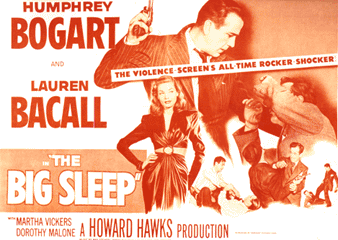
Let’s take a look at the Howard Hawks film of Raymond Chandler’s novel The Big Sleep starring Humphrey Bogart as Philip Marlowe (the 1946 theatrical cut, for the purposes of this discussion). In many ways, I consider both the film and book to be the defining noir story, even though they differ in some very significant ways, and even if it was The Maltese Falcon that “started it.” The Big Sleep was, at the time of its release, one of the most chilling thriller pictures on record. Promotional posters advertised it as “the violence screen’s all-time rocker-shocker.”

It’s hard to imagine this day and age, but it used to be that even one murder was a big deal. Casablanca was advertised as an action picture on the basis of the gunpoint threats and the grand total of two onscreen shootings. Nowadays we talk about the desensitizing effect of seeing the body count run into the double- and triple-digits within the span of a two-hour trip to the cineplex, but back in the day, every snuffing counted.

In The Big Sleep, the trail of corpses beats a lower bound of seven, in a bullet-ridden domino chain of crisscrossing motives and passions. And still, every snuffing counted. After Marlowe kills Canino, the one death he inflicts in the whole adventure, he feels and expresses a modicum of regret sufficient to warrant a kiss from Lauren Bacall.

The censorship regime did its own wonders for film noir’s self-assertion as a mode of storytelling specific to the cinematic medium. The central act of blackmail that sets the plot in motion – dirty pictures of Carmen Sternwood – is referred to in vague, implicit terms. Carmen is fully clothed when Marlowe finds her posing in front of the camera at Geiger’s residence. Marlowe’s amusing charade with Agnes in the bookstore is as someone with an interest in “rare books,” if you take my meaning. And then there’s the 1946 cut’s addition of that legendary dinner between Marlowe and Vivian, arguably Bogart and Bacall’s best scene together in all their collaborations, where they discuss sexual positions with the euphemistic vocabulary of equestrianism.

Chandler’s novel was itself was a rejection of chivalric ideals in favour of a new, gritty realism. Observe the scene (excised from the film, it goes without saying) in Chapter 24 where Marlowe discovers Carmen lying naked in his apartment, and notices an unsolved chess problem nearby:

I looked down at the chessboard. The move with the knight was wrong. I put it back where I had moved it from. Knights had no meaning in this game. It wasn’t a game for knights.

This, from the novel that defined the modern conception of hard-boiled private eye fiction beyond its foundations in Hammett’s Falcon. And to think that on film, yet more of it was left unsaid. Is concealment not what put the “film” in film noir? I hope I have dispensed with the notion with sufficient conviction.

With that out of the way, we lead ourselves back to Miller and Rodriguez with a blunt rhetorical question. Do Sin City and the words “realism” or “censorship” even belong in the same sentence? And I hope you’ve seen the film by now, because in answering that question, I’m going to spoil the film like crazy.

The case for the “no” side is obvious. The exaggerated sensationalism of sex and violence in Sin City places it in an ironic position antithetical to the realism inherent to its generic influence. This is not a negative criticism of the film, but of ignorant critics – both the proponents who will tell you what a good noir flick it is, and the detractors who see it as an exploitative abomination no more than a thin and pale mimetic imitation of the classic noir oeuvre. This is a film to be evaluated on its own terms, and any comparative study would do well to make note of differences instead of merely repeating the observable similarities.

That said, the observable similarities tend to appear in the film at its most critical heights of dramatic tension. For all the amputations, beheadings and castrations in the picture – and that’s just the ABC of Sin City‘s alphabet of gore – it is with the occasional, hardly-noticed spurt of concealment that it makes a brief return to the noir tradition, when what matters is not what you see, but what you don’t.

Perhaps the most noirish scene in all of Sin City is its opening scene, based on the story “The Customer is Always Right” and starring Josh Hartnett as a hitman unaware of his ultimate purpose. The composition exhibits a constructed whiff of nostalgia, and the characters are so fresh off the stock as to remain anonymous. The sudden, silenced jolt as he does away with his unsuspecting “customer” hearkens back to the decisive shot fired at the conclusion of the best noir mystery of the last few years, Spielberg’s Minority Report. Beyond the precision of the staging and the colour palette (black and white, a red dress and blue eyes), it all feels like an elevation of traditional noir conventions to a Platonic ideal. But the movie is just beginning, and something feels off about the scene beyond its manifest artificiality; later, we see that it is a deception in the face of the tone that follows.

The three stories that make up the movie proper aren’t nearly as subdued – what, with Kevin eating hookers and mounting their heads on the wall and Marv subsequently feeding his remains to the dogs in “The Hard Goodbye,” the entire Dwight chapter (“The Big Fat Kill”) centering on a game of hot-potato with Jack Rafferty’s severed head, and Hartigan ripping out a pair of pasty happy-sacks in “That Yellow Bastard.”

The violence does not provoke suspense, though – and it should be noted that it is altogether infrequent next to how some would describe the film. While it is in a sense extreme, it incites disgust at worst, but more often a sort of base and bloodthirsty pleasure. When the skinheaded thug played by Nicky Katt (the voice of Atton in the ending-free computer game Knights of the Old Republic II) is shot through the chest with an arrow, it’s damn funny.

But to me, the violence with the greatest impact is that which is concealed or shrouded – and I don’t mean offscreen. Of all the gunshots fired in the course of this 126-minute thrill ride, the best was saved for last. And you’ll notice that when Hartigan does himself in, it occurs in reverse silhouette, in the same negative space as when Dwight is drowning in tar – backgrounded as what is not present, a white cutout in a blank canvas. It is onscreen, yet it is absent. Or, in the case of the Yellow Bastard’s own ignominious end as he is pounded into a pool of piss-toned gunk, the pounding is obscured, and Hartigan’s rage is all the more visible precisely because the audience is distanced from its expression.

Shot after shot, Sin City drowns you in imagery you cannot fail to notice, thrusting it into the foreground. Film noir doesn’t do that. But every now and then, when you’re not looking, it hits you. It hits you the hardest when you don’t see it hit you, and that’s when film noir rears its shadowy head.

My point, to sum it up, is that one would do Sin City an injustice to praise or dismiss it as merely a parasitic digital-age iteration of a timeless genre infused with the aesthetics of sequential art. It is a dialectic synthesis of different philosophies and as a result, something both original and special.

Annotations (2)


No matter what the future brings

Tuesday, 29 March 2005 — 9:04pm | Film

It’s three months into the calendar year, but the roster of films I already know I intend to see in 2005 has changed remarkably little since I first promised one a month ago. Of course, in my mind, the movie season is not officially underway until Sin City opens later this week, but then again, I have yet to catch Robots, and I still owe a Constantine review.

I’ll preface this by saying that “tentpole” pictures aside, it is usually hard to point out most of the films that will end up among the year’s best even in March. Aside from the big franchises, adaptations and years-in-the-making pet projects by high-profile directors, films worth getting excited about have developed a tendency to come out of the gates in November and December, preceded only by the buzz of the festival circuit and critical preview screenings no more than a month or two in advance. On the other end of the spectrum are films that get marked on the calendar years in advance; Cars and Watchmen are already sitting pretty atop my list for 2006, and there’s a certain release this year that has blocked off a weekend in May since it was officially announced in 1997.

Without further ado, let us proceed categorically.

Star Wars: It would be inaccurate to call Revenge of the Sith (19 May) the movie I’ve been dying to see. It is, properly, the movie I’ve been living to see. This is the film I have been waiting for ever since I started reading and writing about cinema all those years ago when the Prequels were just making it to the drawing board and nobody had any idea what to expect. This is the episode that will lay all the speculation to rest. This is the episode that binds the galaxy together. This is it, and it’s here in less than two months.

Big films by big directors: The biggest of them all is the last one on the release calendar, and that is Peter Jackson’s real dream project, King Kong (14 December). We already know what happened with his runner-up.

Before that, we have the most interesting traditional battle epic in sight, Ridley Scott’s Crusades picture Kingdom of Heaven (6 May). After putting up with several years of cheap imitators (and even failed expensive imitators that may or may not go by the name of Oliver Stone) trying to make their own Gladiator, I’m enthralled to see Scott come back and show them how it’s done – with an ambitious backdrop that has largely been unexplored, to boot.

Then there’s Ron Howard’s latest collaboration with Russell Crowe, the Jim Braddock bio-pic Cinderella Man (3 June). Yes, it’s yet another boxing movie, but yes, it looks like it could be really something. Maybe this is the personal fascination with the Depression era talking, or just an acknowledgment that Crowe is one of the finest actors this generation, and Howard is a good match for him.

Invasion of the literary nerds: Four major classics of the fantasy/sci-fi canon are coming to film this year, and one can only hope they all live up to their namesakes. First down the pipeline is The Hitchhiker’s Guide to the Galaxy (29 April), which is this year’s The Phantom of the Opera in the sense that it has taken far, far too long to get here. But it is arriving at last, and while director Garth Jennings is a big question mark, at least the project is no longer in the hands of Jay Roach. Stephen Fry (the Guide), Warwick Davis (Marvin) and Alan Rickman (Marvin’s voice) are feats of perfect casting, The Vogons are positively full of, um, Vogonity. The trailers make the film look great, though hopefully it will stay true to the Britishness and wit of the source material. As far as actual point-by-point consistency with the book goes, one should expect nothing; even Douglas Adams contradicted himself constantly in every iteration of the story.

Steven Spielberg continues his whirlwind comeback tour of every nook and cranny of science fiction with War of the Worlds (29 June), starring Tom Cruise and penned by Jurassic Park screenwriter David Koepp. The contemporary take on H.G. Wells appears only loosely related to the novel, but it’s Spielberg doing an alien invasion movie – interestingly, the only kind of alien movie he hasn’t done.

Harry Potter and the Goblet of Fire (18 November) is a mixed bag of hype. As the book with the scenes that are most easily imaginable and translatable to pictures, be it the Quidditch World Cup, the Triwizard tasks or the cemetary showdown, it is one to see on opening day. But while director Mike Newell is sufficiently British, he still needs to convince me that he is capable of tackling something of this scope. The worst thing the franchise can do at this point is to turn away from Cuaron’s laudable visual overhauls in The Prisoner of Azkaban, yet it is doing exactly that with the costumes and effects.

Shrek director Andrew Adamson is more immediately convincing as the right man for The Lion, the Witch and the Wardrobe (9 December), especially when you consider that also attached to the project are composer Harry Gregson-Williams (Chicken Run and Shrek), Richard Taylor’s WETA dream team (fresh off The Lord of the Rings), and Tilda Swinton as the White Witch. This is a formula for enchantment if I ever saw one.

Comic books: There are three coming out this year that have really piqued my interest, and none of them are associated with Marvel. All of them, to some extent, represent a certain maturation in comic book adaptations to film. The first is Sin City (1 April), which already looks like the best translation of the graphic novel look to motion pictures in history, and possibly the most audacious adoption of a print aesthetic since Warren Beatty’s Dick Tracy fifteen years ago. Even the best serious graphic novel adaptations to date, however stylish, have remained first and foremost motion pictures in the traditional vein – Road to Perdition comes to mind. Sin City looks to graft several stories from Frank Miller’s noirish underworld straight to film with an all-star cast.

For all his popularity, I still think Batman has not been given a proper cinematic treatment, and Batman Begins (17 June) may be the first. Directed by Memento‘s Christopher Nolan, starring a very fitting Christian Bale as Bruce Wayne and finally featuring the Scarecrow as a screen villain, this is the Warner/DC response to Marvel’s recent success in capturing the superhero mystique. It is a necessary and long-overdue reset of how the franchise has traditionally been treated. The one real concern, if it can be called that, is that Sin City makes Batman Begins look so standard and safe. The comparison is less than superficial, since Frank Miller practically created the modern conception of the character in The Dark Knight Returns and went on to revive interest in the early period with Year One.

Last but not least is V For Vendetta (4 November), the next title to fly the Vertigo banner and the latest attempt to do Alan Moore justice. As I discussed in an earlier post, if James McTeigue and company stay true to the British subtleties of the original and do not deviate too far in the direction of The Matrix, we should be in for a treat.

Feature animation: CG is now the talk of the town, but the most exciting prospects in the world of animation this year are both done in stop-motion Claymation. The biggest one to watch out for is the first Wallace & Gromit feature film, The Curse of the Wererabbit (7 October). Anyone with even a passing familiarity with Aardman Animation’s oeuvre should already be aware there is ample reason to plan the weekend around this movie. You should too.

Opening shortly before it is Tim Burton’s spiritual followup to The Nightmare Before Christmas, the early Hallowe’en treat Corpse Bride (23 September). Watch the trailer, and you will agree.

I won’t miss Madagascar (27 May), even if I am hardly a fan of the Dreamworks Animation approach. This one looks slick and stylized, and the penguins are great; and if there is any substance under the promise of fun, it would be a much-appreciated bonus. Hopefully, the topical-for-a-minute-only humour that plagued a certain attempt at a shark movie is kept to a minimum in favour of amusement that comes from the animation itself. To this end, note said penguins.

Finally there is Chicken Little (4 November), Disney’s maiden voyage into all-CG waters. I can’t say I expect this film to be any more significant than the standard offerings we are seeing from the major non-Pixar animation studios, but I really do hope it is a cut above the rest. The performance of Chicken Little is a double-edged sword in that if it succeeds, the possibility of traditional Disney animation coming back anytime soon is even more unlikely; yet if it does not succeed, then Disney’s long sickness will look all the more terminal. But on balance, I want to see a good movie.

Assuming they see release: There are two films that have already made the rounds elsewhere but, to my knowledge, have yet to reach distribution deals that will bring them to Alberta screens anytime soon. The first is Downfall (Der Untergang), Germany’s 2004 Oscar nominee for the Foreign Language award, a story of the collapse of the Third Reich from Hitler’s perspective. Awhile back, Stephen wrote a fantastic post about why this is a film to watch out for, and I see no need to repeat him further. With any luck, the arthouses will pick it up soon.

The other significant film that has only been exhibited in a limited capacity, but should really go everywhere, is Dream On Silly Dreamer, a 40-minute documentary about the death of traditional animation at Walt Disney, as told by the animators themselves. There is still surprisingly little public awareness of the tragedy that has befallen the state of American animation, and it is a story that I would like to see told. Word on the film has been overwhelmingly positive, and I want to see the results for myself.

And everything else: As I said at the beginning of this piece, the landscape will probably look completely different by summer’s end. I still have to hear more about Cameron Crowe’s Elizabethtown and Steven Spielberg’s film about the Munich Olympics (tentatively entitled Vengeance), and who knows what else will come out of the woodwork. On the release calendar, I should take note of two more films. First is Kung Fu Hustle (22 April), the latest comedy from Shaolin Soccer director/star Stephen Chow, who is one of the few directors in the world who still understands how to pull off silly slapstick that not only gets you rolling on the floor laughing yourself to tears, but without being stupid. Well, not too stupid. Unlike Shaolin Soccer‘s Stateside release, which was handled by Miramax, Hustle is being carried by Sony Pictures Classics, which consistently has the balls to release Asian films unmolested.

Buried deep in the release schedule right before the onslaught of the Galactic Empire, but not to be overlooked, is Unleashed (13 May). It is my belief that Jet Li has yet to be given the respect he deserves in English-language film as an actor, not just a fancy-schmancy kung fu guy. From what I can tell, this time around he has a chance to stretch his legs as a performer working under a story premise that is actually compelling. The film is written by Luc Besson and directed by one of his stable of proteges, though as an aside, Besson should really return to directing himself. None of the pseudo-Bessons have ever produced anything on the level of Léon (The Professional) or The Fifth Element, even though they have his style down on the surface. But even though Besson has instead chosen the path of becoming a French Jerry Bruckheimer, even Bruckheimer delegated a good film or two, and Unleashed looks promising.

And that’s a wrap. I see a preview screening of Sin City tomorrow, so hopefully I will return with comments at some point in the near future. Until then, chide me for my unintended omissions.

Annotations (0)


How to shred the Maple Leaf

Monday, 21 March 2005 — 6:38pm | Classical, Music, Pianism

As some of you know, I played a banquet Saturday night (that being the National Debating Championships formal), accompanying Happnin’ alto and fellow debater Maria Chen. Word is that we survived the dinner performance in spite of a horribly out-of-tune B natural above middle C that forced us to work around the charts we set to sharp keys, and the precarious decision to situate my personal decorative glass of red wine on the grand when the wheels were not locked in. I can’t speak to any of this myself, as I wasn’t listening.

Later in the evening, as I took a break for dinner, some random attendee who had earlier attempted to run off with my precious Hal Leonard “Little” commandeered the piano in my place, approaching it in much the same way as Draco Malfoy would treat a Hippogryph. Now, he was hardly without skill, though a brief conversation on technique I had with him about Gershwin’s changes in “Let’s Call The Whole Thing Off” revealed him to be new to substitution. But one should remember that skill is very different from finesse, and while some finesse is bound to be lacking even for the relatively seasoned improviser – I’ll freely admit that I somewhat butchered Koji Kondo’s “athletic” Donut Plains theme from Super Mario World – there is really little excuse to throw it out the window for cheap tricks when it comes to playing something fully composed.

There is a very simple litmus test for rooting out rank amateurs who try to show off at the keys with little respect for the music they are performing, especially when that music is ragtime. This performer I speak of, whom I have yet to identify, committed the crime of trying to play “Maple Leaf Rag” as fast as he could.

I don’t see why people insist on butchering “Maple Leaf Rag” the way they do. It’s marked Tempo di marcia, but there is no end of piano hacks who play it not as a march so much as a hundred-horse cavalry charge. Well, the guns of Aqaba may face the sea, but anyone who has ever bothered to take Scott Joplin, ragtime and stride seriously is not so inattentive, and knows that ragtime is never played fast.

Observe the following tempo markings. “Elite Syncopations”: Not fast. “The Easy Winners”: Not fast. “The Entertainer” – yes, that “Entertainer”: Not fast. Joplin’s sheets to “Fig Leaf” and “Sugar Cane” carry a little box on Page 1 akin to a Surgeon General’s warning: “NOTE – Do not play this piece fast. It is never right to play ‘Ragtime’ fast.”

“Maple Leaf Rag”: For the love of all that be Good and Holy, dare I invoketh the honoured rolls of Tin Pan Alley and Preservation Hall, do not ever play this piece fast, you simple-minded irreverent blasphemous fool. Or, in other words, Tempo di marcia.

It is especially appalling that even performers who are otherwise professionals of a calibre well beyond that of my own still drag “Maple Leaf” through the mud at tempos befitting the Autobahn for a spurt of cheap amateur showmanship. Over the summer, I saw the keyboard player in a band performing on as prestigious a jazz-tourist destination as the Mississippi steamship Natchez do the exact same thing. Technically, he was a talented performer with a good sense of syncopated rhythm who had huge hands that graced progressive tenths with ease. I think he was blind, too, but I’m not sure. But for goodness’ sake, that is not by any means a license to play ragtime as fast as you can.

Maybe it comes of how most people are exposed to ragtime in the form of ice cream delivery vehicle jingles and cellular telephone ringtones, but I do not presume to know the origin of this tragically widespread interpretation. Now, I’m not one to commit the intentional fallacy and say that ragtime shouldn’t be played fast because Joplin said so, but I am one to say that to a literate musician, it sounds like ass. There are pieces that you can play as fast as you can to show off to your friends – “burner” swings like Ellington’s “Take the ‘A’ Train” and Kondo’s “athletic” Donut Plains theme from Super Mario World. “Maple Leaf Rag” is not one of these pieces.

The tournament itself was fantastically run by the organizers behind the curtains, and they have really done the club proud. After adjudicating one round I was pulled into a swing team (which, in debate lingo, is a placeholder team to even out odd numbers) with Dan Sirbu, who had never done a Canadian Parliamentary tournament before. After cleaning up in the first two rounds, we dropped like rocks in the other four. I think it was a positive experience for my partner, though; it’s not every day that a complete novice gets the beneficial learning experience of being creamed, eviscerated, and totally wiped out by Jo Nairn and Ren in the later bracketed rounds of a competition. And I say that in earnest, as nothing drives you to improve so much as being done in by the best of the lot.

Congratulations to Mike Kotrly and Rahool Agarwal, who won the tournament this year after a second-place finish apiece in the last two Nationals. Mikey I’ve talked about, but Rahool was also someone I was quite glad to see win. Yesterday, he definitely slowed down from the rapid-fire rhetoric he used to display, but he remained as analytically thorough as ever. Rahool was on his way out of Alberta in my novice year, and much of the values and debating philosophies to which I subscribe bear traces of his influence. For such an accomplished orator who was well aware of the distinction between good and bad debate and never hesitated to point it out, he was always eager to train us newcomers. It’s been a long road to the title, but he earned it.

Annotations (2)


« Back to the Future (newer posts) | A Link to the Past (older posts) »